Storm Damage Restoration in Duncanville
Storm damage restoration in Duncanville and surrounding areas. Insurance billing accepted. Call (682) 772-9123.
What Storm Damage Restoration actually involves
A severe storm doesn’t just break windows — it creates a sequence of damage that compounds by the hour. A tree limb punches through a roof at 2 a.m., and by morning the attic insulation has absorbed enough rainwater to weigh twice what it should. Wind-driven rain forces itself under siding, behind fascia boards, and through soffit gaps that look perfectly intact from the ground. The visible damage — the missing shingles, the crushed fence, the scattered debris — is almost never the whole story.
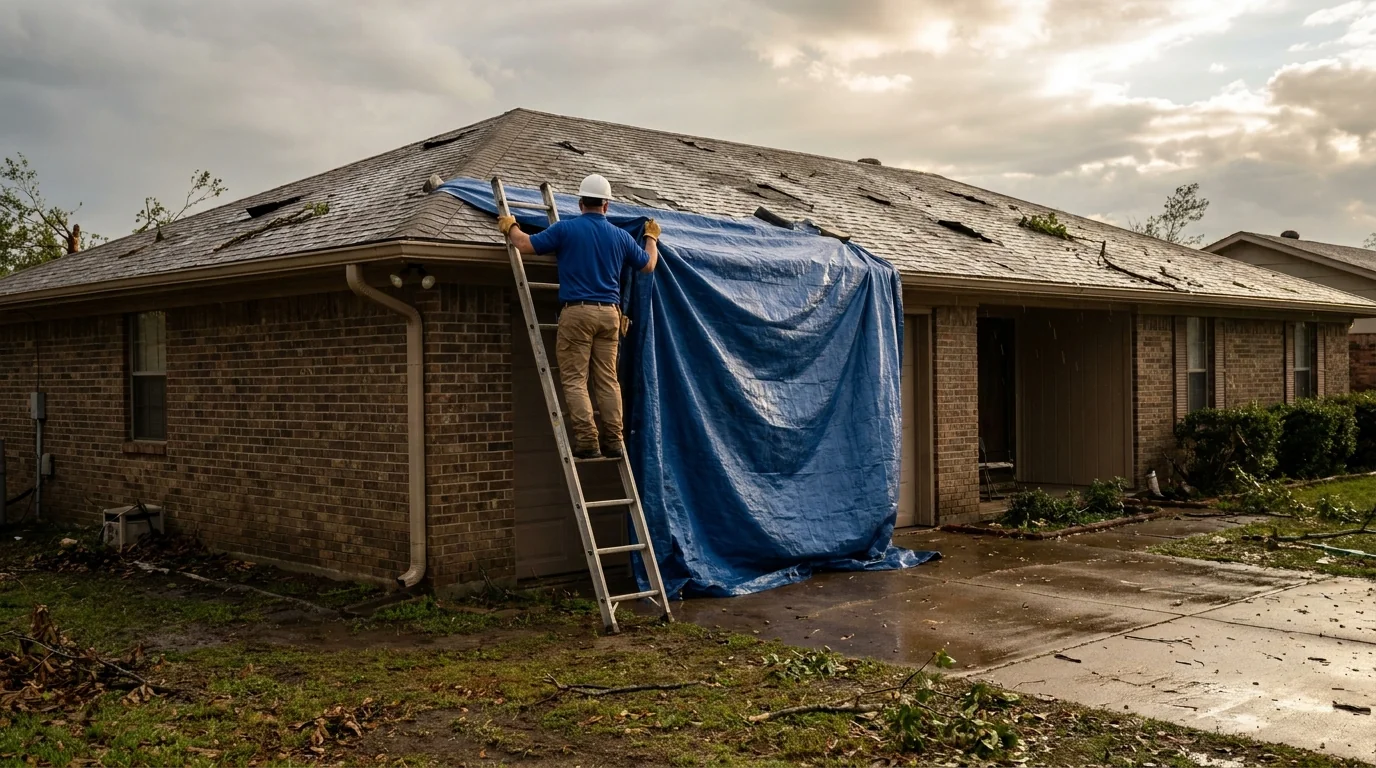
Storm damage restoration means working through that full sequence: emergency tarping and board-up to stop the bleeding, then systematic documentation of every affected material before anything is removed or dried. Crews use moisture meters and thermal imaging cameras to trace water migration through wall cavities and subfloor assemblies. Structural members are assessed for wind uplift damage that may not be obvious until the wet insulation is pulled away. Debris removal, temporary weatherproofing, and controlled drying all happen in parallel, not in a tidy one-thing-at-a-time order.
Timeline depends on severity, but most residential storm losses move through emergency stabilization within the first 24–48 hours, structural drying over the following 3–5 days, and repair or reconstruction in the weeks after. Delays in that first window — even a single day of standing moisture in a wall cavity — can turn a straightforward claim into a mold remediation job on top of everything else.
Our process
1. Emergency stabilization and weatherproofing Before any assessment happens, the structure needs to stop taking on more damage. That means roof tarps secured with proper ballast (not just draped), plywood board-up on breached windows and doors, and temporary fencing or barriers where structural collapse is a concern. Cutting off the water source — whether that’s rain intrusion or a broken supply line exposed by impact — is step one.
2. Damage documentation and scope development Every affected surface gets photographed and logged before it’s touched. Moisture readings are recorded at multiple depths in walls, ceilings, and floors using pin and pinless meters. Thermal imaging identifies hidden wet zones that look dry on the surface. This documentation isn’t just for the insurance adjuster — it’s the map that drives every decision in the repair phase. Missing a wet zone at this stage means discovering mold six weeks later.
3. Debris removal and material separation Storm debris gets sorted on-site: structural materials that can be salvaged, materials that are too saturated or damaged to dry in place, and hazardous items (broken glass, roofing nails, insulation batts) that require separate handling. Interior contents are moved and protected before any demolition begins. Selective demolition — removing only what can’t be saved — keeps the scope manageable and the insurance documentation clean.
4. Structural drying and moisture monitoring Commercial desiccant or refrigerant dehumidifiers, high-velocity air movers, and in some cases injection drying systems for wall cavities run continuously until moisture readings return to baseline for the region and material type. Daily monitoring logs track progress and give the insurance carrier verifiable data that drying was performed to standard — not just “until it felt dry.”
5. Repair and reconstruction coordination Once the structure is dry and stable, the repair scope is finalized. That may mean roofing, siding, window replacement, framing repairs, drywall, insulation, and interior finishing — handled as a coordinated sequence rather than a series of disconnected subcontractors showing up out of order. Permits are pulled where required. Final inspections close the job.
What separates a good storm damage response from a bad one
The most common failure point in storm damage work is incomplete moisture mapping in the first 48 hours. A crew that replaces the roof and patches the drywall without tracing where the water actually traveled leaves saturated wall cavities sealed behind new finishes — a mold problem that surfaces months later and is almost impossible to tie back to the original claim.
A second common gap is documentation quality. Insurance adjusters for major carriers — State Farm, Allstate, USAA, Farmers — are looking for line-item Xactimate estimates backed by photographs, moisture logs, and material specifications. Vague invoices or missing photos create supplement disputes that delay payment and sometimes leave homeowners holding costs the policy should have covered.
Experienced operators also know to look for secondary damage that’s easy to miss under pressure: wind uplift on roof decking that looks intact but has broken the adhesive bond between layers, siding that appears undamaged but has allowed water intrusion behind the housewrap, and foundation drainage issues exposed or worsened by the storm event.
Seasonal and regional considerations
North Texas sits in one of the most active severe weather corridors in the country. The Dallas–Fort Worth Metroplex — including Duncanville, DeSoto, Cedar Hill, Mansfield, and the surrounding communities — sees peak hail and tornado activity from March through June, with a secondary severe weather window in the fall. Hail damage to roofing and siding is the single most common storm loss in this region, and it’s frequently underestimated: a roof that passes a visual inspection from the ground may have significant granule loss and mat bruising that only shows up on close inspection.
Summer thunderstorms in the area can drop several inches of rain in under an hour, overwhelming gutters and foundation drainage systems on homes throughout southern Dallas County. The clay-heavy soil common in this part of Texas holds water near foundations longer than sandy soils would, which extends the drying timeline for any below-grade or slab-adjacent materials.
Service area
MCC Restoration and Contracting Services is based in Duncanville and handles storm damage restoration throughout southern Dallas County and the surrounding areas — including DeSoto, Cedar Hill, Lancaster, Midlothian, Mansfield, Grand Prairie, and Arlington. Dedicated service-area pages cover the specifics of each city; this page covers the full scope of what storm damage restoration involves regardless of location.
If a storm has hit your property and you’re not sure where the damage ends, call (682) 772-9123 to schedule a thorough storm damage assessment. The sooner the moisture mapping and documentation happen, the cleaner your claim and your repair will be.
Frequently Asked Questions
What should I do to protect my property while waiting for a storm damage crew to arrive?
How do contractors find water damage that isn't visible after a storm?
My roof looks okay from the ground after the hailstorm — does it still need an inspection?
What documentation does my insurance adjuster actually need for a storm damage claim?
Can storm damage to siding or roofing lead to mold even if the interior looks dry?
Looking for the best storm damage restoration company in Duncanville?
MCC Restoration and Contracting Services provides storm damage restoration in Duncanville, TX and the surrounding area. Call (682) 772-9123 for a free estimate.
Need Storm Damage Restoration now?
We respond fast across Duncanville and surrounding TX cities.
Related Coverage
- Our Restoration Services
- Contact MCC Restoration and Contracting Services
- Storm Damage Restoration in Cedar Hill
- Storm Damage Restoration in Dallas
- Storm Damage Restoration in DeSoto
- Storm Damage Restoration in Duncanville
- Storm Damage Restoration in Grand Prairie
- Storm Damage Insurance Claim Checklist (Use This Before You Call Your Insurer)