Mold Remediation in Duncanville
Mold remediation in Duncanville and surrounding areas. Insurance billing accepted. Call (682) 772-9123.
You noticed it first by smell — that damp, earthy odor coming from behind the drywall or under the bathroom vanity. Then you saw the discoloration: dark patches spreading along a baseboard, fuzzy growth tracing the grout lines in a shower corner, or a greenish-black bloom on the ceiling below a slow roof leak. Mold doesn’t announce itself until it’s already colonized. Within 24–48 hours of moisture exposure, spores that were dormant in your walls, subfloor, or HVAC system can begin reproducing — and by the time the smell is obvious, the affected area is almost always larger than what’s visible.
What mold remediation actually involves
Mold remediation is not the same as mold removal. Scrubbing a surface with bleach kills surface cells but leaves the mycelium — the root structure — intact inside porous materials like drywall, wood framing, and insulation. True remediation means physically removing contaminated material, controlling airborne spore counts, and verifying through post-clearance testing that the indoor air quality has returned to an acceptable baseline.
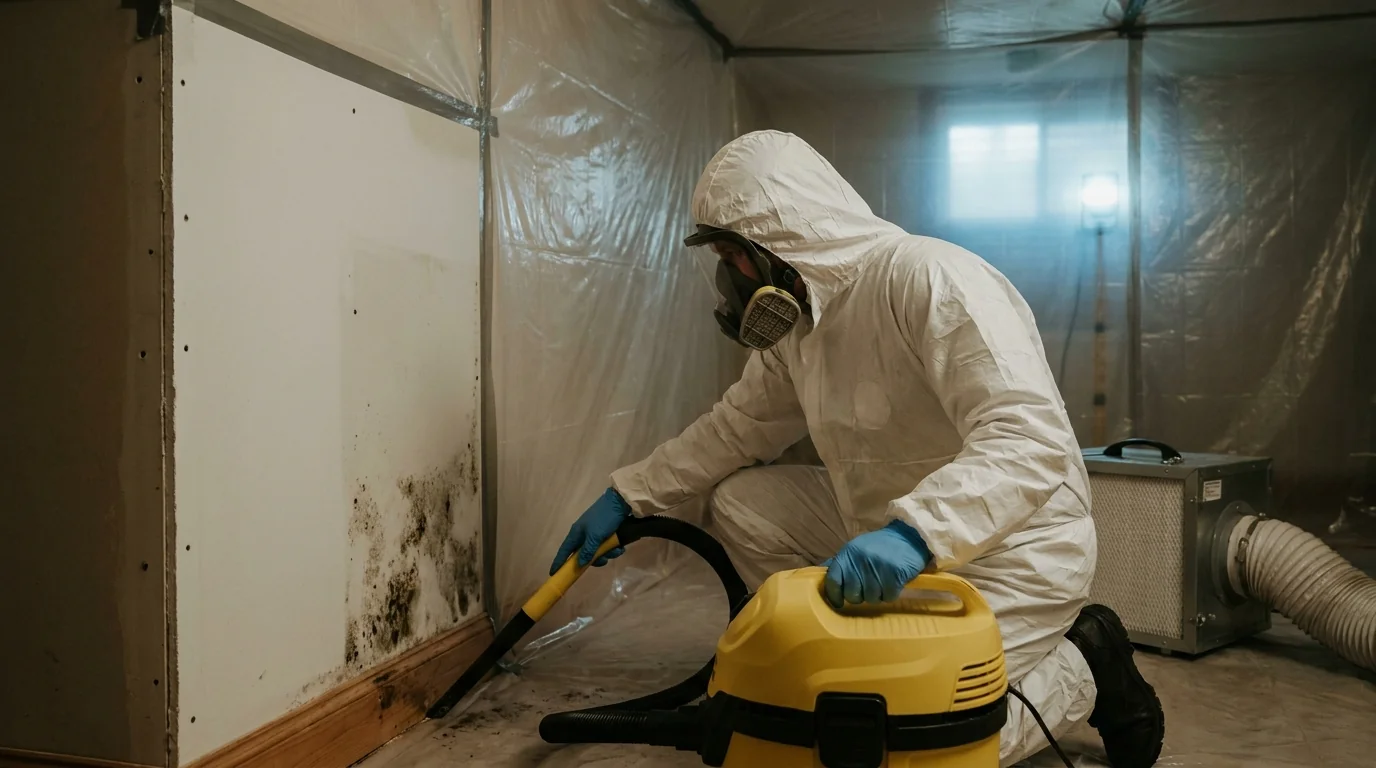
The work involves negative air pressure containment barriers (typically 6-mil poly sheeting with zipper doors), HEPA-filtered air scrubbers running continuously during the job, and personal protective equipment for every technician on-site. Affected drywall, insulation, and sometimes structural wood is bagged and removed. Hard surfaces are HEPA-vacuumed, then wiped with an EPA-registered antimicrobial solution. The goal is to get the spore count inside the containment zone to match — or fall below — the outdoor ambient count, which is what a clearance air sample will measure.
A straightforward bathroom or crawl space job typically takes one to three days of active remediation. Larger losses involving attic systems, HVAC contamination, or multi-room spread can run a week or more, particularly when structural drying must be completed before remediation can begin.
Our process
-
Inspection and moisture mapping. Before any containment goes up, we identify every moisture source feeding the growth. Mold is a symptom — the leak, condensation problem, or vapor intrusion is the disease. We use moisture meters and thermal imaging to trace water migration behind walls and under flooring, because treating visible mold while leaving wet substrate guarantees regrowth.
-
Containment and negative air pressure. We isolate the work area with poly barriers and run HEPA air scrubbers in negative pressure mode. This pulls air through the containment and exhausts it outside, preventing spores disturbed during demolition from migrating into clean areas of the home. HVAC registers inside the zone are sealed for the duration of the job.
-
Controlled demolition and material removal. Contaminated porous materials — drywall, insulation, carpet, wood trim — are removed, double-bagged in 6-mil poly, and disposed of properly. We don’t cut corners by attempting to encapsulate material that needs to come out; encapsulation over active mold growth is a short-term fix that fails.
-
HEPA vacuuming, antimicrobial treatment, and dry time. All remaining structural surfaces inside the containment are HEPA-vacuumed to remove settled spores, then treated with an EPA-registered antimicrobial agent. We allow adequate dry time before clearance testing — rushing this step is one of the most common ways a remediation fails its final air sample.
-
Clearance verification. Post-remediation air samples or surface swabs confirm that spore counts have returned to acceptable levels before containment comes down. This documentation matters for insurance claims and for your own peace of mind before reconstruction begins.
What separates a good mold remediation from a bad one
The most common failure point is incomplete moisture source identification. A crew that removes visible mold without confirming the substrate is dry — or without finding the original water intrusion — will see regrowth within weeks. Insurance adjusters reviewing a re-occurrence claim will look hard at whether the original scope addressed the moisture source, not just the mold itself.
A second frequent shortcut is inadequate containment. Without true negative pressure, demolition work aerosolizes spores throughout the living space. Homeowners sometimes report that their allergy symptoms got worse after a remediation — that’s often a sign that spores were spread rather than controlled during the job.
Finally, clearance testing is skipped more often than it should be. A verbal assurance that “it looks clean” is not the same as an air sample showing spore counts at or below outdoor ambient levels. If your contractor doesn’t offer or recommend post-remediation verification, that’s worth asking about before work begins.
Seasonal and regional considerations
North Texas humidity patterns create specific mold risk windows. The stretch from late spring through early fall — when outdoor dew points regularly sit above 65°F — means that any unaddressed moisture intrusion in a Duncanville home can produce visible mold growth faster than it would in a drier climate. Crawl spaces and pier-and-beam foundations common in older Dallas-area neighborhoods are particularly vulnerable: warm, humid outdoor air contacts cool soil and creates the condensation conditions mold needs.
Attic mold is another regional pattern worth mentioning. Poor ridge or soffit ventilation combined with summer attic temperatures causes moisture cycling that feeds mold on roof decking — often without any active leak present. If you’re seeing staining on upper-floor ceilings, the attic is worth inspecting before assuming the roof is the source.
Service area
MCC Restoration and Contracting Services is based in Duncanville and serves communities throughout the southwestern Dallas metro, including Cedar Hill, DeSoto, Lancaster, Midlothian, Mansfield, and Grand Prairie. The city-specific pages linked from this section cover local considerations for each area — but the remediation process and standards described here apply across the entire service footprint.
If you’re seeing signs of mold growth or dealing with a recent water loss that wasn’t fully dried, call (682) 772-9123 to schedule an air quality assessment. The earlier the inspection, the smaller the scope of work tends to be.
Frequently Asked Questions
What's the difference between mold remediation and mold removal, and why does it matter?
When does mold remediation require full containment with negative air pressure, versus a simpler cleanup approach?
How do I know the mold remediation actually worked — what does clearance testing involve?
What should I do — and not do — in the area where I found mold before a remediation crew arrives?
Can mold grow back after a professional remediation, and what prevents it?
Looking for the best mold remediation company in Duncanville?
MCC Restoration and Contracting Services provides mold remediation in Duncanville, TX and the surrounding area. Call (682) 772-9123 for a free estimate.
Need Mold Remediation now?
We respond fast across Duncanville and surrounding TX cities.
Related Coverage
- Our Restoration Services
- Contact MCC Restoration and Contracting Services
- Mold Remediation in Cedar Hill
- Mold Remediation in Dallas
- Mold Remediation in DeSoto
- Mold Remediation in Duncanville
- Mold Remediation in Grand Prairie
- How To Choose a Restoration Company in Duncanville (Without Getting Burned)
- How To Test for Mold in Your Home (DIY Kits vs a Pro Inspection)
- 7 Signs You Have Hidden Mold (and What To Do Next)