Water Damage Restoration in Duncanville
Water damage restoration in Duncanville and surrounding areas. Insurance billing accepted. Call (682) 772-9123.
What happens in the first 48 hours matters more than anything else
A burst pipe under your kitchen sink. A water heater that failed overnight. A washing machine supply line that let go while you were at work. By the time you find standing water on your floor, the clock is already running — and not in your favor. Within 24 to 48 hours, saturated drywall begins to lose structural integrity, wood subfloors start to cup and swell, and the moisture conditions that mold needs to colonize are already forming. Water damage restoration is the work of stopping that clock before the damage compounds.
What water damage restoration actually involves
Water damage restoration is not mopping up and running a fan. The visible water is usually the smallest part of the problem. Water migrates — it travels through wall cavities, wicks up baseboards, pools beneath flooring, and saturates insulation inside walls where no one can see it. Effective restoration means finding all of it, not just the part you can see.
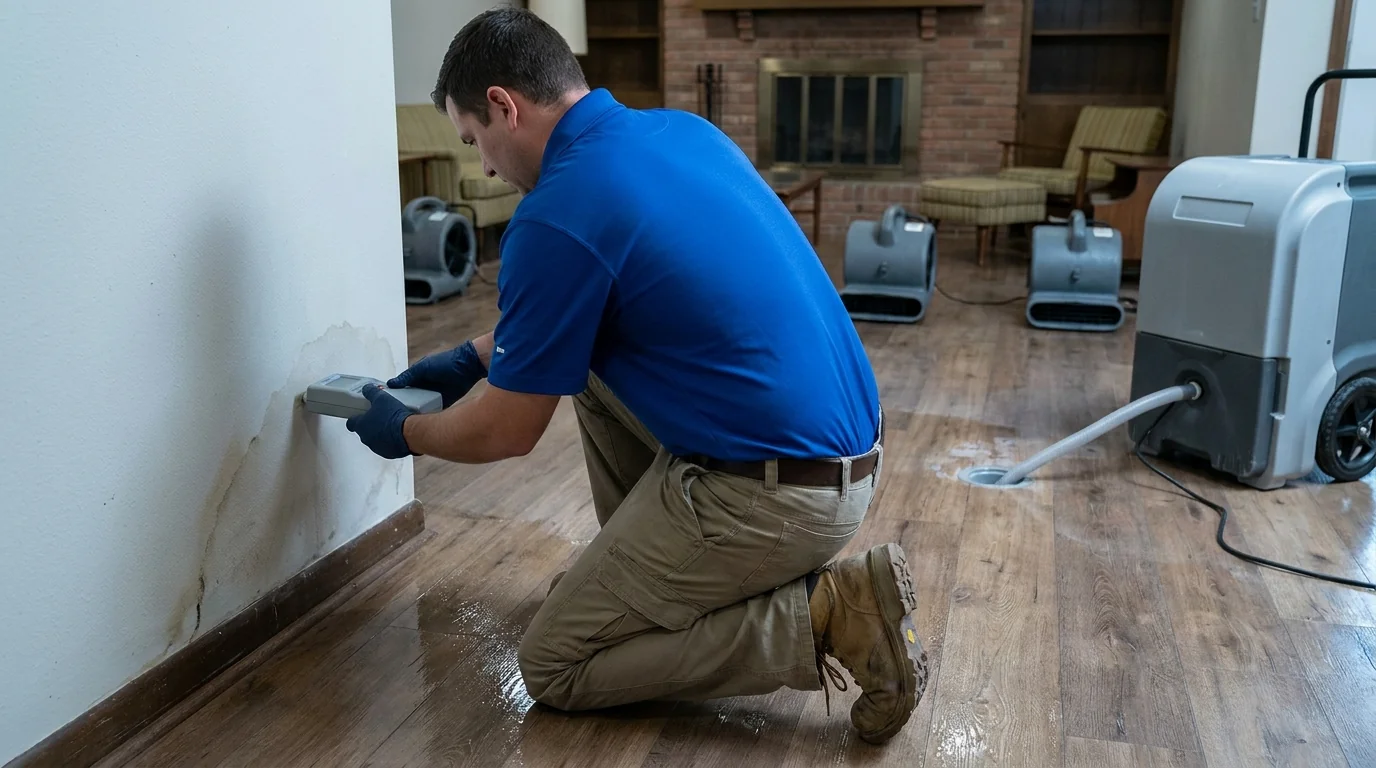
The work begins with water extraction using truck-mounted or portable extraction units capable of pulling hundreds of gallons out of flooring and carpet quickly. Once standing water is removed, industrial air movers and refrigerant or desiccant dehumidifiers take over — not the kind you buy at a hardware store, but commercial-grade equipment designed to create controlled airflow that forces moisture out of building materials and into the air, where dehumidifiers capture it.
Throughout the drying phase, moisture readings are taken daily using thermal imaging cameras and pin-type or pinless moisture meters. The goal is a documented drying log that shows moisture levels dropping toward the material’s dry standard — the kind of documentation an insurance adjuster will ask for. Drying typically takes three to five days for a Category 1 clean-water loss in a standard residential space, though Category 2 (gray water) and Category 3 (sewage or floodwater) losses require additional containment and antimicrobial treatment that extends the timeline.
Our process
-
Damage assessment and water classification — Before any equipment goes in, the source is identified and the water category is determined. Category 1 (clean water from a supply line) is handled differently than Category 2 (gray water from an appliance overflow) or Category 3 (black water from sewage backup or flooding). The category determines the safety protocols, the scope of demolition required, and what materials can be dried in place versus removed.
-
Water extraction — High-capacity extractors remove standing water from hard floors, carpet, and carpet pad. Carpet pad is almost always non-salvageable and is removed at this stage. In Category 2 and 3 losses, affected porous materials that cannot be adequately cleaned are also removed before drying begins.
-
Structural drying with monitored equipment placement — Air movers are positioned to create a vortex effect along walls and under flooring. Dehumidifiers are sized to the cubic footage of the affected area. Equipment placement is not guesswork — it follows a calculated drying plan. Moisture readings are logged at each visit, typically daily, to confirm the structure is drying on schedule.
-
Antimicrobial treatment — On Category 2 and 3 losses, affected surfaces receive EPA-registered antimicrobial application after extraction and before final drying to address microbial contamination introduced by the water source.
-
Final moisture verification and documentation — When all readings reach the target dry standard, a final inspection confirms the structure is ready for reconstruction. The complete drying log — dates, readings, equipment used — is compiled for your insurance claim file.
What separates a good water damage response from a bad one
The most common mistake in water damage response is under-drying. A crew pulls the visible water, sets a few fans, and returns in two days to declare the job done — without ever confirming that wall cavities, subfloor assemblies, or cabinet toe-kicks have reached acceptable moisture levels. The result is mold growth behind walls three to four weeks later, a much larger remediation bill, and a coverage dispute with your insurer over whether the damage was pre-existing.
Insurance adjusters look for a few things that distinguish a professional loss response: a written moisture map showing where readings were taken, daily drying logs with actual numbers, and documentation that the water category was correctly identified. A Category 3 loss that was treated as Category 1 — without proper containment or antimicrobial treatment — is a liability problem and a health concern.
Another frequent miss is failing to check adjacent rooms and the floor below the loss. Water follows gravity and the path of least resistance. A second-floor bathroom leak will almost always affect the ceiling cavity and wall framing of the room below, even when the floor above looks contained.
Seasonal and regional considerations
North Texas weather creates specific water damage patterns worth knowing. The Dallas–Fort Worth area, including Duncanville and the surrounding communities, sees hard freezes that arrive fast and hit pipes that were never insulated for sustained cold — supply lines in exterior walls, garage connections, and irrigation backflow preventers are common failure points. The winters of 2021 and 2023 both produced significant pipe-burst claims across the region.
On the other end of the calendar, the late spring storm season brings roof damage, window intrusion, and foundation drainage failures. Homes in older Duncanville neighborhoods — many built in the 1970s and 1980s — often have cast-iron drain lines and older plumbing connections that are more vulnerable to failure during temperature swings.
Service area
MCC Restoration and Contracting Services is based in Duncanville and serves the surrounding communities throughout the DFW Metroplex, including Cedar Hill, DeSoto, Grand Prairie, Mansfield, Midlothian, and beyond. Each city-specific page links back here for the full technical detail on how water damage restoration works.
If you are standing in a wet room right now, call (682) 772-9123 to schedule your moisture assessment. The sooner readings are taken, the clearer the picture of what dried on its own — and what didn’t.
Frequently Asked Questions
How long does structural drying typically take, and what affects that timeline?
What is the difference between Category 1, Category 2, and Category 3 water damage, and why does it matter for cleanup?
What should I do — and not do — while waiting for the restoration crew to arrive?
How do I know if my walls are still wet even after the floors feel dry?
What documentation should I keep for my insurance claim after a water loss?
Looking for the best water damage restoration company in Duncanville?
MCC Restoration and Contracting Services provides water damage restoration in Duncanville, TX and the surrounding area. Call (682) 772-9123 for a free estimate.
Need Water Damage Restoration now?
We respond fast across Duncanville and surrounding TX cities.
Related Coverage
- Our Restoration Services
- Contact MCC Restoration and Contracting Services
- Water Damage Restoration in Cedar Hill
- Water Damage Restoration in Dallas
- Water Damage Restoration in DeSoto
- Water Damage Restoration in Duncanville
- Water Damage Restoration in Grand Prairie
- Burst Pipe Checklist: Step-by-Step Response
- What To Do in the First 24 Hours After Water Damage
- How To Choose a Restoration Company in Duncanville (Without Getting Burned)