Water Damage Restoration in Dallas
Water damage restoration in Dallas, TX. Insurance billing accepted. Call (682) 772-9123.
Our crews are dispatched from our Duncanville, TX headquarters and respond quickly to projects across Dallas.
When a pipe fails inside a Kessler Park craftsman built in the 1930s, the water doesn’t just pool on the floor — it wicks into original hardwood, soaks through horsehair-plaster walls, and disappears into a crawl space before the homeowner realizes the full extent of the loss. Southern Dallas carries a specific combination of aging infrastructure, expansive clay soil, and a spring storm season that can drop three inches of rain in under an hour, and that combination makes water damage here faster-moving and harder to dry than most people expect. MCC Restoration and Contracting Services responds to water losses across Dallas from our Duncanville base, and we know what these properties actually look like on the inside.
Why Dallas Properties See Water Damage Issues
The housing stock across southern Dallas spans nearly a century of construction, and each era brings its own failure points. In Oak Cliff and the streets surrounding Kessler Park, homes built between the 1920s and 1950s often still run on galvanized steel supply lines and cast-iron drain stacks. Galvanized pipe corrodes from the inside out — the exterior looks intact until a section collapses and releases water inside a wall cavity. Cast-iron drains crack under the pressure of Dallas’s shrink-swell clay soil, which shifts several inches seasonally and stresses underground lines with every wet-dry cycle.
Move south toward Red Bird and Mountain Creek, and the housing stock shifts to 1970s–90s tract construction: copper supply lines that have been in service for 40-plus years, polybutylene fittings on some units that were never replaced after the class-action settlements of the 1990s, and slab foundations that hide plumbing leaks until moisture migrates far enough to surface through tile grout or buckle laminate flooring.
Then there’s the weather. Spring supercell systems tracking across the DFW Metroplex regularly produce hail that punctures roof membranes and drives water into attic insulation. Creek-adjacent streets near the Trinity River Greenbelt and the drainage corridors feeding into it flood during flash-rain events that overwhelm storm infrastructure designed for a different era. When that water enters a structure, the clock starts immediately.
Our Water Damage Restoration Process in Dallas
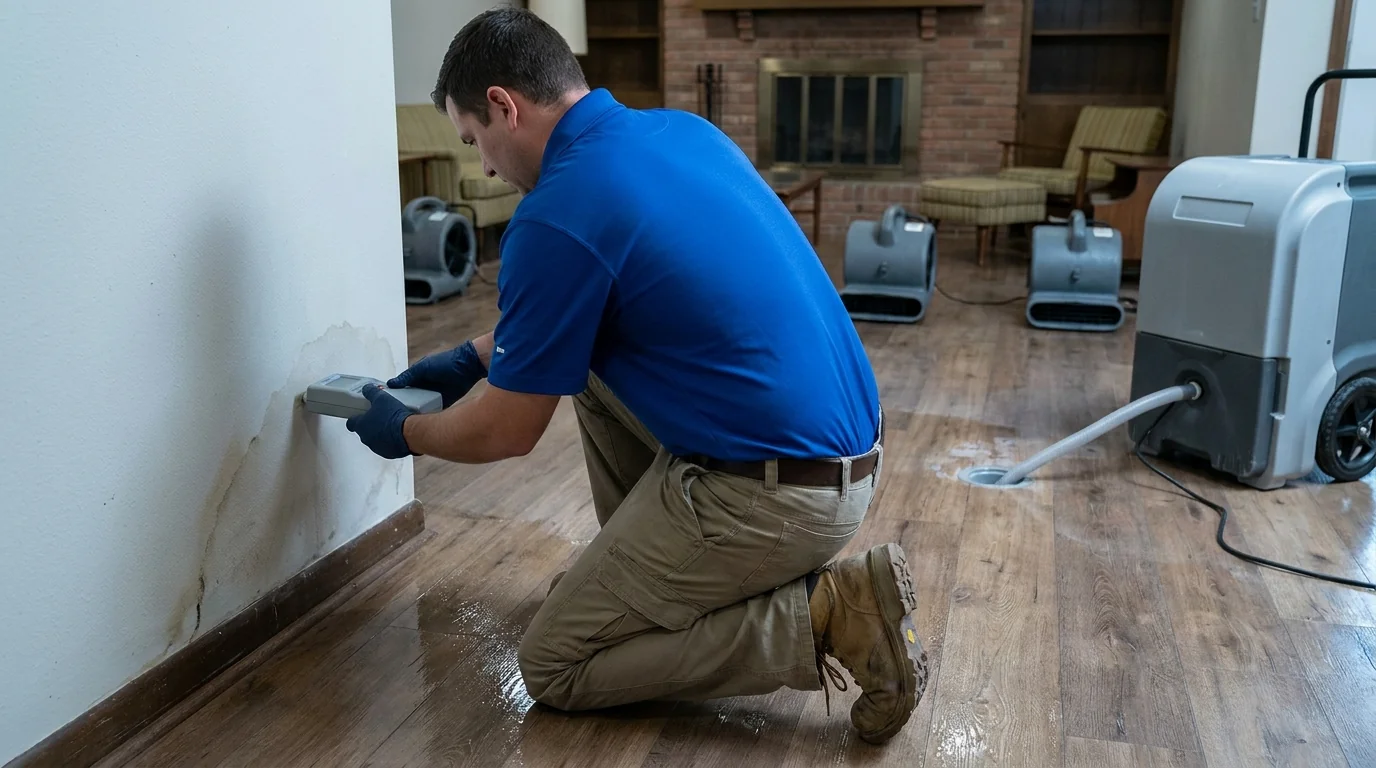
The first step on any water loss is stopping the source and assessing how far moisture has traveled — two things that sound simple but require systematic moisture mapping, not a visual scan. We use thermal imaging and calibrated moisture meters to trace water migration through walls, subfloors, and ceiling assemblies before we move a single piece of equipment.
Once the scope is mapped, water extraction comes first. Standing water in a slab-on-grade home in the 75232 ZIP code gets pulled with truck-mounted extraction equipment; a finished basement or crawl space in an older Oak Cliff property may require portable units and specialty attachments to reach water that has pooled in confined areas.
After extraction, structural drying begins. We calculate the number and placement of air movers and dehumidifiers based on the actual cubic footage and material types in the affected space — not a one-size estimate. Drying logs are recorded daily so we can document moisture levels over time, which matters both for confirming the structure is genuinely dry and for supporting an insurance claim with objective data.
If building materials are saturated beyond recovery — sections of drywall, insulation batts, subfloor sheathing — controlled demolition removes them before they become a mold substrate. We work to preserve what can be dried in place and replace only what cannot.
Reaching Dallas from Duncanville
Our shop sits in Duncanville, which puts us a short drive up Highway 67 or I-20 into the heart of southern Dallas. Oak Cliff, the Bishop Arts District, Red Bird, and the neighborhoods clustered around Kiest Park are all well within our regular service area — these aren’t distant calls for us, they’re the addresses we see most often. Properties along the I-35E corridor and out toward Dallas Executive Airport are similarly close. When you call (682) 772-9123, you’re reaching a crew that is already familiar with the streets, the housing types, and the access quirks of these neighborhoods.
Local Note
One thing that catches homeowners off guard in Kessler Park and the older sections of Oak Cliff: the original plaster walls in pre-1950 homes absorb water more slowly than modern drywall, but they release it slowly too. A wall that reads “wet” on a moisture meter after a pipe burst may take significantly longer to reach drying standards than a comparable drywall assembly — sometimes 30 to 50 percent longer. That’s not a problem if you know to expect it and set drying equipment accordingly, but it’s a real issue if a crew pulls equipment on day three assuming the job is done. We account for this in our drying projections on any pre-war structure so there are no surprises at the final moisture reading.
If you’re dealing with water damage anywhere in Dallas — a burst supply line in an Oak Cliff bungalow, storm intrusion in a Red Bird ranch home, or a commercial water loss in a multifamily building near I-35E — call MCC Restoration and Contracting Services at (682) 772-9123. We’ll assess the damage honestly, document it thoroughly, and dry the structure correctly the first time.
Water Damage Restoration in Dallas: Service Coverage
Frequently Asked Questions
How quickly can MCC reach Oak Cliff or Kessler Park from your Duncanville location?
Are older Oak Cliff and Kessler Park homes more likely to have hidden water damage after a pipe failure?
Does Dallas's clay soil affect how water damage is handled on slab-foundation homes in areas like Red Bird or Mountain Creek?
What does the structural drying process actually involve, and how do you know when a Dallas home is genuinely dry?
How does MCC document a water loss for an insurance claim in Dallas?
Water Damage Restoration in Dallas
Our crews are based in Duncanville, TX and take on projects across Dallas. Call for a free estimate.