Fire Damage Restoration in Dallas
Fire damage restoration in Dallas, TX. Insurance billing accepted. Call (682) 772-9123.
Our crews are dispatched from our Duncanville, TX headquarters and respond quickly to projects across Dallas.
When a kitchen fire tears through a 1940s bungalow in Kessler Park or a grease fire chars the cabinets of a Red Bird tract home, the damage rarely stops at the visible char line. Smoke travels through every gap in original balloon-frame construction, soot settles into plaster walls that have absorbed decades of paint, and the acrid smell of burned wood and synthetic materials embeds itself in materials long before a homeowner can assess the full scope. MCC Restoration and Contracting Services responds to fire losses across Dallas — from the older housing corridors of Oak Cliff to the 1970s–90s neighborhoods near Mountain Creek — and we treat each job as the structural and environmental event it actually is.
Why Dallas Properties See Distinctive Fire Damage Challenges
Dallas’s southern neighborhoods carry two very different building profiles, and both create specific complications after a fire. The historic homes around Kessler Park and the broader Oak Cliff corridor — many built between the 1920s and 1950s — feature original wood-lath and plaster walls, balloon-frame cavities that run floor-to-ceiling without fire blocking, and decades of layered paint that can include lead-based coatings. When fire moves through those open cavities, smoke and heat travel vertically with little resistance, meaning upper floors and attics absorb damage even when the fire itself stayed on the first floor.
In contrast, the 1970s–90s tract homes in Red Bird and Mountain Creek were built with platform framing and early synthetic materials — carpet padding, vinyl flooring, and composite cabinetry — that produce particularly dense, oily soot when they burn. That petroleum-based residue bonds to surfaces differently than wood smoke and requires specific chemical agents to lift without spreading it deeper into porous materials.
Dallas’s spring supercell season adds another layer: tornado and hail events can breach roofs just before or after a fire, meaning a structure is simultaneously exposed to weather intrusion and fire damage. Coordinating board-up, tarping, and fire restoration in that sequence requires a clear plan from the first hour on site.
Our Fire Damage Restoration Process in Dallas
Every fire loss we handle moves through a documented sequence, not a checklist that gets abbreviated when the job looks manageable.
Emergency stabilization comes first — securing the structure, boarding openings, and placing roof tarps to prevent secondary water intrusion from Dallas’s unpredictable spring and summer storms. If the fire department used suppression water, we begin extracting standing water from floors before it migrates under subfloor materials.
Scope and documentation follows immediately. We photograph and catalog every affected surface and material for the insurance claim file, noting pre-existing conditions separately so there is no ambiguity in the adjuster review. For older Oak Cliff homes, we flag any materials that may require lead or asbestos testing before demolition proceeds — a step that matters both for worker safety and for keeping the project on a legal footing with Texas regulations.
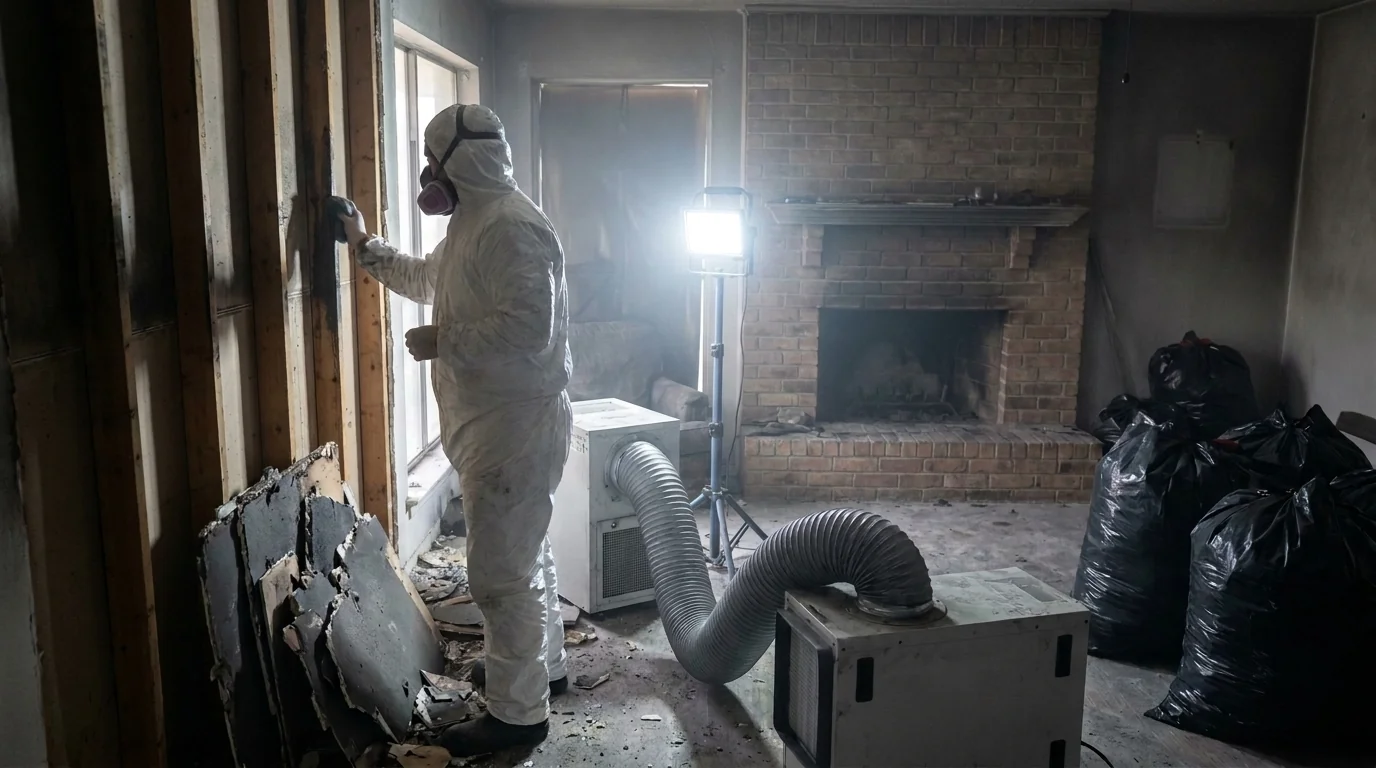
Soot and smoke removal is the most labor-intensive phase. We use dry chemical sponges on loose soot before any wet cleaning begins, then apply appropriate cleaning agents matched to the soot type — dry smoke from fast-burning wood fires responds differently than the wet, smeared residue left by slow-smoldering synthetic materials. HEPA air scrubbers run continuously to capture airborne particulates throughout this phase.
Deodorization addresses what cleaning alone cannot. Thermal fogging and hydroxyl generation are deployed based on the size of the structure and the depth of odor penetration. In homes with original plaster walls — common in the ZIP codes 75211 and 75224 — odor can persist inside wall cavities even after surface cleaning, and we account for that in the treatment plan.
Structural repair and reconstruction closes the job. We handle the rebuild under the same contract so there is no gap between the mitigation crew and the contractor — no period where a gutted room sits open waiting for a separate company to mobilize.
Reaching Dallas from Duncanville
MCC’s base in Duncanville sits just south of the Dallas city line, which puts our crews close to the neighborhoods that generate the most fire loss calls. The drive up Highway 67 or I-20 reaches the Oak Cliff and Bishop Arts District corridors quickly, and we know the surface street patterns through Red Bird and the Kiest Park area well enough to avoid the bottlenecks that slow down crews unfamiliar with southern Dallas. For properties near the Mountain Creek or Trinity River Greenbelt edges, we factor in the access routes that can close during flash-rain events — a real consideration in a region where a single storm cell can drop several inches in under an hour.
Dallas Insurance Coordination
Fire claims in Dallas typically involve a field adjuster visit before any significant demolition, and we build our documentation process around that timeline. We provide a written scope with line-item detail, photographs keyed to each damaged area, and moisture readings where suppression water was used — the format most Texas carriers expect. For homeowners in older Oak Cliff neighborhoods where replacement costs for original materials (old-growth lumber, plaster, period millwork) can exceed standard schedule values, we note those items explicitly so the adjuster has the information needed to authorize accurate coverage.
Local Note
Kessler Park’s historic homes present a specific sequencing issue that isn’t obvious until you’ve worked in them: the original cast-iron drain lines and galvanized supply plumbing in these structures are often already stressed by Dallas’s expansive clay soil, and fire department suppression water moving through the system at high volume can push failing joints past their limit. We check drain and supply lines for new leaks as part of our post-fire walkthrough — not because it’s standard protocol everywhere, but because finding a slow drain leak behind a wall two weeks after fire restoration is complete is a problem we’ve learned to prevent rather than fix.
If fire has damaged your Dallas property, call MCC Restoration and Contracting Services at (682) 772-9123. We’ll assess the full scope — structural, smoke, and odor — and walk you through exactly what comes next before any work begins.
Fire Damage Restoration in Dallas: Service Coverage
Frequently Asked Questions
How quickly can MCC reach a fire-damaged home in the Oak Cliff or Kessler Park area from your Duncanville location?
Do the older homes in Oak Cliff and Kessler Park require different fire restoration methods than newer Dallas construction?
What type of soot do Red Bird and Mountain Creek tract homes typically produce, and does it affect the cleanup process?
Will my Texas homeowner's insurance cover fire damage restoration, and how does MCC help with the claim process?
How long does fire damage restoration typically take for a single-family home in the 75211 or 75224 ZIP codes?
Fire Damage Restoration in Dallas
Our crews are based in Duncanville, TX and take on projects across Dallas. Call for a free estimate.