Fire Damage Restoration in Cedar Hill
Fire damage restoration in Cedar Hill, TX. Insurance billing accepted. Call (682) 772-9123.
Our crews are dispatched from our Duncanville, TX headquarters and respond quickly to projects across Cedar Hill.
Cedar Hill sits at one of the highest elevations in North Texas, and that geography does more than deliver sweeping views — it channels wind across the White Rock Escarpment in ways that can turn a contained kitchen fire into a whole-house smoke event before a crew arrives. When fire moves through a home in Lake Ridge or the Bear Creek area, the combination of hilltop drafts, vaulted ceilings common in the area’s 2000s custom builds, and the clay-heavy soil that keeps foundations shifting means the damage rarely stays where it started. MCC Restoration and Contracting Services, based in nearby Duncanville, responds to fire losses across Cedar Hill’s 75104 and 75106 ZIP codes and understands the specific conditions that shape how fire and smoke behave in this community.
Why Cedar Hill Properties See Distinct Fire Damage Patterns
The escarpment elevation that makes Cedar Hill State Park and Joe Pool Lake so scenic also makes roofs and attic spaces vulnerable to wind-driven ember intrusion during brush fires — a real concern given how closely residential neighborhoods border open parkland. In High Pointe and Lake Ridge, newer homes built on sloped lots often have complex rooflines with multiple valleys and penetrations; fire can travel into attic cavities through soffit vents before occupants realize the exterior has been compromised.
On the other end of the spectrum, Cedar Hill’s historic downtown corridor contains structures with balloon-frame or platform-frame construction dating back several decades. In those buildings, fire moves vertically through wall cavities with almost no resistance, and the older plaster-and-lath assemblies hold heat longer than modern drywall — meaning thermal damage extends further from the origin point than a homeowner would expect.
Appliance and electrical fires are common across both older and newer housing stock. The escarpment clay that keeps foundations moving also stresses the plumbing and conduit running through them; over time, that movement can compromise junction boxes and gas line connections in ways that create ignition risk.
Our Fire Damage Restoration Process in Cedar Hill
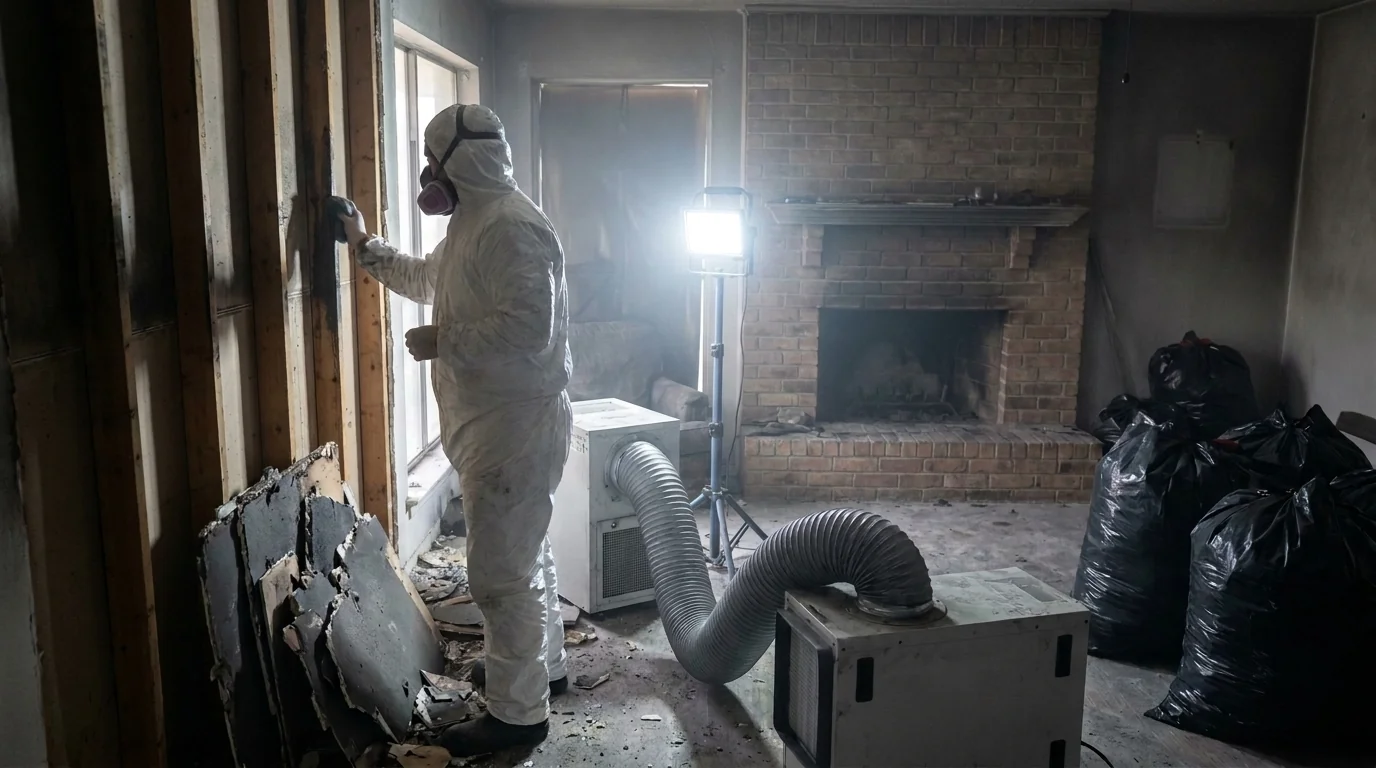
Every fire loss is different, but the sequence of decisions that determines whether a home is fully restored — or partially rebuilt — follows a disciplined path. The process begins with a thorough structural and content assessment: we document what burned, what was heat-damaged without burning, and what carries smoke or soot residue that will cause ongoing odor and corrosion if left untreated.
Soot is not uniform. Protein-based soot from kitchen fires leaves a nearly invisible, intensely odorous film on every surface in the room. Synthetic-material fires — common when modern furnishings ignite — produce a wet, smearing residue that bonds to walls and HVAC surfaces. We identify the soot type before selecting cleaning chemistry, because using the wrong approach can permanently set staining into drywall and cabinetry.
Once surfaces are cleaned, odor neutralization moves beyond masking. Thermal fogging and hydroxyl treatment reach into wall cavities, ductwork, and subfloor spaces where smoke particles settle and linger. In Cedar Hill’s custom homes with open floor plans and high ceilings, this step requires more time and equipment placement than a standard single-story layout — we account for that in the project scope rather than discovering it mid-job.
Structural repairs — from replacing fire-damaged framing to restoring finished surfaces — are handled under the same project, so homeowners deal with one point of contact from emergency response through final walkthrough.
Cedar Hill Insurance Coordination
Fire claims in Cedar Hill tend to involve multiple damage categories: the fire itself, water damage from suppression, and sometimes wind or hail damage to roofing that was already present before the loss. Carriers want those categories separated in the documentation, and adjusters will push back on estimates that bundle them without clear line-item support.
MCC documents each damage category independently — photographs, moisture readings, scope notes — so the claim file holds up under review. We work directly with adjusters and can meet on-site during the inspection, which speeds the approval process considerably. Homeowners in Lake Ridge’s master-planned sections sometimes also face HOA requirements around exterior repair materials and paint colors; we flag those early so the rebuild scope doesn’t create a second round of approvals after the insurance work is done.
Local Note
In Cedar Hill’s Bear Creek area and along the escarpment-facing slopes of Lake Ridge, homes built in the early-to-mid 2000s frequently have spray-foam insulation in attic cavities — a feature that was marketed as an energy upgrade but complicates post-fire restoration significantly. Spray foam chars rather than burns cleanly, and charred foam cannot be cleaned; it has to be mechanically removed and replaced, which adds both labor and material cost that standard fire estimates often miss. If your home has a sealed attic assembly, make sure your restoration contractor scopes that area explicitly before the insurance estimate is finalized.
If fire or smoke damage has affected your Cedar Hill home, call MCC Restoration and Contracting Services at (682) 772-9123. We’ll assess the full scope of the loss, coordinate with your insurance carrier, and walk you through a clear restoration plan — from emergency stabilization through finished repairs.
Fire Damage Restoration in Cedar Hill: Service Coverage
Frequently Asked Questions
How quickly can MCC reach a fire-damaged home in the Lake Ridge or High Pointe area of Cedar Hill?
Cedar Hill homes near the state park border sometimes have brush-fire exposure — does that change how you assess the damage?
Does Cedar Hill's older downtown housing stock require a different restoration approach than the newer master-planned neighborhoods?
What types of soot are most common after a residential fire, and how does the cleanup differ?
Will my Cedar Hill homeowner's insurance cover both the fire damage and the water damage left by suppression?
Fire Damage Restoration in Cedar Hill
Our crews are based in Duncanville, TX and take on projects across Cedar Hill. Call for a free estimate.