Mold Remediation in Cedar Hill
Mold remediation in Cedar Hill, TX. Insurance billing accepted. Call (682) 772-9123.
Our crews are dispatched from our Duncanville, TX headquarters and respond quickly to projects across Cedar Hill.
Cedar Hill sits atop the White Rock Escarpment — one of the highest elevations in the Dallas–Fort Worth metroplex — and that geography does something most homeowners don’t expect: it accelerates mold. Heavy spring storms roll in off Joe Pool Lake, drive rain sideways into roof penetrations and soffit vents, and then the humidity lingers inside walls while the clay-heavy soil beneath slows drainage. By the time you smell something musty in a Lake Ridge custom home or notice discoloration along a basement-level wall in the Bear Creek area, mold colonies may have been quietly growing for weeks. MCC Restoration and Contracting Services handles mold remediation across Cedar Hill — containment, removal, and verified drying — so the problem gets resolved, not painted over.
Why Cedar Hill Properties See Mold Issues
The escarpment clay that defines Cedar Hill’s terrain is notoriously slow to drain. After a heavy rain event, water doesn’t just run off — it pools against foundation walls, seeps through slab joints, and saturates crawl spaces before it finally dissipates. Lake Ridge, developed largely in the 2000s on sloped lots, sees this pattern regularly: grading that looked fine at build time shifts as clay expands and contracts through Texas seasons, redirecting runoff toward the structure rather than away from it.
Older properties near Cedar Hill’s historic downtown face a different set of conditions. Aging supply lines and drain stacks — some original to mid-century construction — are more prone to slow pinhole leaks behind walls. Those leaks often go undetected for months because the water never reaches a visible surface. By the time a homeowner notices a soft spot in drywall or a persistent musty odor, mold has already colonized the paper facing on the insulation and the back side of the wall cavity. Mold can begin colonizing a wet surface in as little as 24 to 48 hours; a slow leak that runs for three weeks creates a very different remediation scope than a single burst pipe.
Our Mold Remediation Process in Cedar Hill
Every job starts with a thorough inspection — moisture readings with a calibrated meter, thermal imaging where wall cavities are suspect, and visual documentation of all affected areas. We don’t guess at scope; we map it. That matters in Cedar Hill because the escarpment’s wind exposure means attic spaces are frequently the first place mold establishes after a storm loosens flashing or cracked a ridge cap.
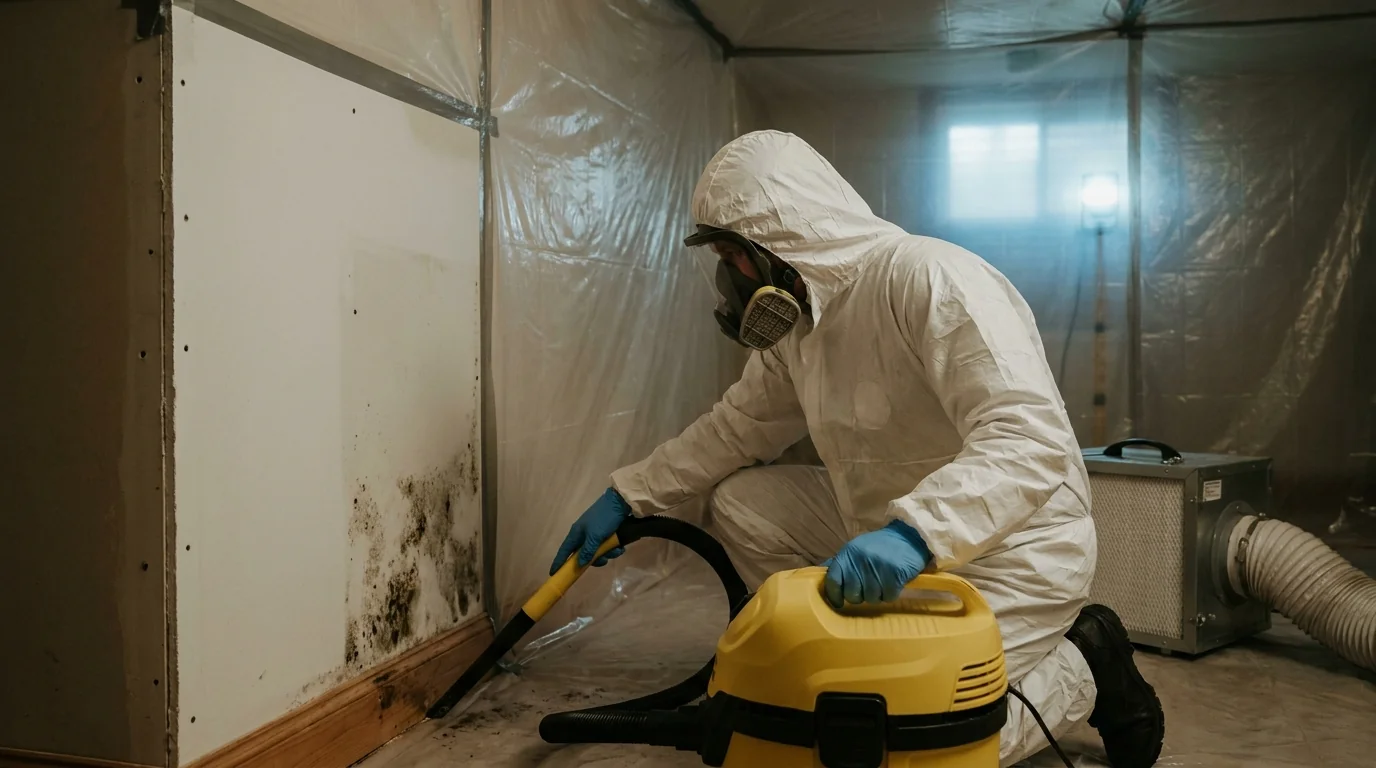
Once scope is confirmed, we establish negative-air containment barriers to prevent spores from migrating to unaffected rooms during removal. Affected materials — drywall, insulation, framing in severe cases — are removed, bagged, and disposed of per EPA guidelines. HEPA air scrubbers run continuously throughout the process. After removal, surfaces are treated with an EPA-registered antimicrobial agent. We then verify drying with post-treatment moisture readings before any reconstruction begins. We don’t consider a job complete until the numbers confirm it.
Reaching Cedar Hill from Duncanville
MCC Restoration is based in Duncanville, which puts Cedar Hill well within our regular service area — the two cities share a border along the US-67 corridor. From our Duncanville location, we can reach most Cedar Hill addresses, including neighborhoods in the 75104 ZIP code, without the extended drive times that out-of-area contractors face. For properties near Cedar Hill State Park or in the western sections of Lake Ridge, we typically route via FM 1382, which keeps travel time predictable even during peak hours. When you call (682) 772-9123, our team can give you a realistic arrival window based on your specific address.
Cedar Hill Insurance Coordination
Mold remediation claims in Cedar Hill follow the same general pattern as the broader DFW market, but the cause of loss matters enormously for coverage. Insurance carriers typically distinguish between mold resulting from a sudden, covered event — like a burst pipe — and mold resulting from long-term moisture intrusion, which many policies exclude. We document the loss thoroughly: moisture mapping, photographs of affected materials, written scope of work, and a clear timeline of the damage. That documentation gives your adjuster what they need to process the claim accurately. We work directly with most major carriers and can communicate with your adjuster on your behalf to reduce the back-and-forth.
Local Note
One thing we’ve observed working in Cedar Hill’s newer master-planned sections: homes built on cut-and-fill lots along the escarpment slopes sometimes have HVAC returns positioned in areas that draw air from partially unconditioned spaces — a crawl space access panel left slightly ajar, or a chase that connects to an attic section. When mold develops in those spaces, the HVAC system can distribute spores throughout the living area before anyone realizes there’s a source. If you’re in Lake Ridge or High Pointe and you’re seeing unexplained allergy symptoms that worsen indoors, it’s worth having the air handler and return pathways inspected as part of any mold assessment — not just the walls.
If you’ve noticed signs of mold growth, a persistent musty odor, or recent water intrusion anywhere in Cedar Hill, call MCC Restoration and Contracting Services at (682) 772-9123. We’ll assess the situation honestly, explain what remediation actually involves for your specific property, and get the work done right.
Mold Remediation in Cedar Hill: Service Coverage
Frequently Asked Questions
Are homes in Lake Ridge more prone to mold than other Cedar Hill neighborhoods?
How does Cedar Hill's clay soil affect mold remediation scope?
What does mold remediation typically involve for a mid-century home near Cedar Hill's historic downtown?
How do you confirm mold remediation is complete — not just visually clean?
Does homeowner's insurance typically cover mold remediation for Cedar Hill properties affected by storm-driven water intrusion?
Mold Remediation in Cedar Hill
Our crews are based in Duncanville, TX and take on projects across Cedar Hill. Call for a free estimate.