Sewage Cleanup and Sanitization in Duncanville
Sewage cleanup and sanitization in Duncanville and surrounding areas. Insurance billing accepted. Call (682) 772-9123.
When a sewer line backs up or a septic system overflows, the clock starts immediately — not just for the cleanup, but for your health. Raw sewage contains bacteria like E. coli and Salmonella, hepatitis A virus, and parasites that can survive on porous surfaces for days. Within 24 to 48 hours, Category 3 contamination (what the industry calls “black water”) begins wicking into drywall, subfloor, and insulation. The smell hits you first. The structural damage and microbial colonization come next, quietly, behind walls you can’t see.
What sewage cleanup and sanitization actually involves
Sewage cleanup is not a mop-and-bleach job. The contamination travels — along floor joists, under baseboards, into wall cavities wherever the water found a path. Effective removal means tracing that migration with moisture meters and thermal imaging before a single piece of drywall comes down.
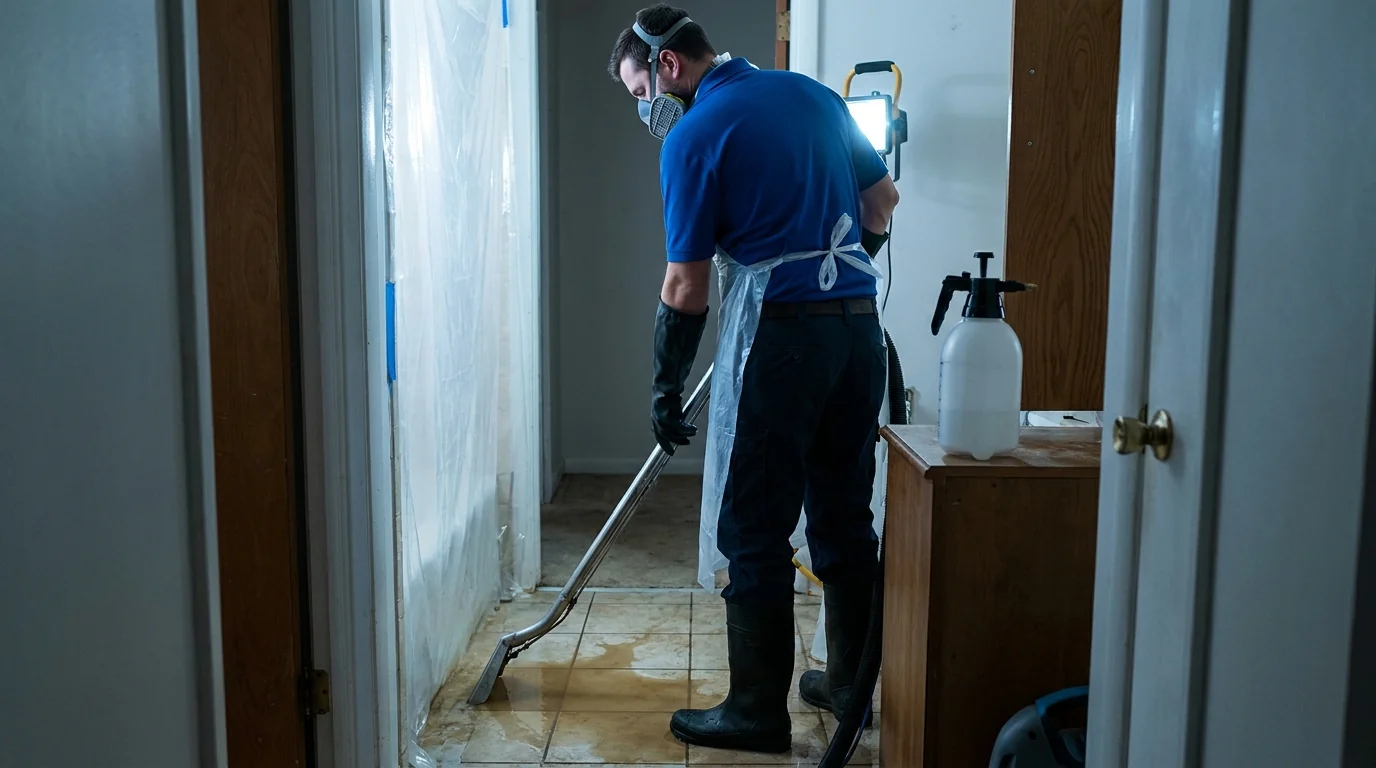
Once the scope is mapped, the physical work involves extracting standing sewage using truck-mounted or portable extraction units, removing and bagging all saturated porous materials (flooring, drywall, insulation) that cannot be adequately sanitized, and treating remaining structural surfaces with EPA-registered hospital-grade disinfectants. Odor control is its own phase — enzymatic treatments break down the organic compounds that cause persistent sewage smell rather than masking them with fragrance. Drying equipment (air movers, dehumidifiers) runs afterward to bring structural materials back to acceptable moisture levels and prevent secondary mold growth.
Timeline from first call to dry structure typically runs 3 to 5 days depending on how far the contamination spread and how long it sat before cleanup began.
Our process
-
Containment and safety staging. Before any extraction begins, the affected area is isolated to prevent cross-contamination to clean zones. Technicians suit up in appropriate PPE — gloves, respirators, protective suits — and establish a decontamination corridor. This step is skipped by inexperienced operators and is the most common reason contamination spreads to adjacent rooms.
-
Contamination mapping. Moisture meters and thermal imaging cameras trace exactly where the sewage traveled. Sewage follows gravity and capillary action, so the visible wet area is rarely the full affected area. Mapping before demolition prevents both under-removal (leaving contaminated material behind) and unnecessary tear-out.
-
Extraction and controlled demolition. Standing sewage is extracted first. Saturated porous materials — carpet, pad, drywall, insulation, hardwood flooring — are removed, double-bagged, and disposed of properly. Solid waste is handled separately. Any material that absorbed Category 3 water and cannot be surface-sanitized comes out. There is no gray area on this.
-
Disinfection and deodorization. Exposed structural surfaces (concrete slab, floor joists, wall studs, subfloor) are cleaned of visible contamination and then treated with EPA-registered disinfectants rated for sewage pathogens. Enzymatic deodorizers are applied to break down organic residue at the molecular level. This is distinct from odor masking — if the enzymatic step is skipped, the smell returns within weeks.
-
Structural drying and clearance. Air movers and dehumidifiers run until moisture readings in structural materials return to baseline. Final readings are documented before equipment is pulled. This documentation matters for your insurance claim and protects against a mold remediation bill six months later.
What separates a good sewage cleanup from a bad one
The most common failure mode is incomplete removal. A crew that extracts standing water, sprays bleach, and runs fans for a day has not completed sewage cleanup — they’ve dried contaminated material in place. Bleach is not a substitute for an EPA-registered disinfectant applied to a properly prepped surface, and it does nothing for organic odor compounds.
Insurance adjusters look for moisture logs with timestamped readings, a written scope that identifies which materials were removed versus retained and why, and documentation of the disinfectant products used (including EPA registration numbers). A claim without that paper trail is harder to close and easier to dispute.
The other common miss is the subfloor. Sewage that soaks through vinyl or tile into the wood subfloor below is invisible until the floor starts to buckle or smell returns. Thermal imaging during the mapping phase catches this before it becomes a much larger repair.
Seasonal and regional considerations
Duncanville and the surrounding DFW area sit on expansive clay soils that shift significantly with moisture changes. During dry summers, that soil contraction puts lateral stress on older clay sewer lines, accelerating joint separation and root intrusion — two of the most common causes of sewer line backups in established neighborhoods. After heavy rain, saturated soil reduces the drainage rate for septic systems, making overflow events more likely in homes on private septic in the southern and western edges of the service area.
North Texas also sees freeze events that can crack exposed sewer laterals, typically in January and February. A backup that follows a hard freeze warrants a camera inspection of the line before restoration is considered complete.
Service area
MCC Restoration and Contracting Services is based in Duncanville, TX and handles sewage backup cleanup, raw sewage removal, and septic overflow cleanup throughout the surrounding area — including Cedar Hill, DeSoto, Lancaster, Midlothian, Mansfield, Grand Prairie, and the southern Dallas metro. City-specific service pages for each of these areas link back to this page for full process detail.
If you are dealing with a sewage backup right now, call (682) 772-9123 to speak directly with someone who can walk you through immediate steps and schedule your sewage cleanup and sanitization service.
Frequently Asked Questions
What is Category 3 water, and why does it change how sewage cleanup is handled?
Can sewage contamination spread to rooms that didn't have standing water?
What should I do — and not do — while waiting for the cleanup crew to arrive?
Why does sewage smell come back even after a cleanup, and how is it permanently eliminated?
Does a sewer line backup need a camera inspection before restoration is considered complete?
Looking for the best sewage cleanup and sanitization company in Duncanville?
MCC Restoration and Contracting Services provides sewage cleanup and sanitization in Duncanville, TX and the surrounding area. Call (682) 772-9123 for a free estimate.
Need Sewage Cleanup and Sanitization now?
We respond fast across Duncanville and surrounding TX cities.