Sewage Cleanup and Sanitization in Dallas
Sewage cleanup and sanitization in Dallas, TX. Insurance billing accepted. Call (682) 772-9123.
Our crews are dispatched from our Duncanville, TX headquarters and respond quickly to projects across Dallas.
When a sewer line backs up into a home near the Trinity River Greenbelt or a septic system overflows in the Mountain Creek area, the clock starts immediately — raw sewage carries pathogens that begin penetrating porous surfaces within hours. Southern Dallas presents a specific combination of aging infrastructure, expansive clay soil, and storm-driven surges that makes sewage events here more complicated than a simple pump-and-dry job. MCC Restoration and Contracting Services operates out of Duncanville, putting crews close to the neighborhoods where these calls happen most.
Why Dallas Properties See Sewage Backup Issues
The housing stock across Oak Cliff and Kessler Park tells the story clearly. Homes built between the 1920s and 1950s were plumbed with cast-iron drain lines and galvanized supply pipes — materials that have spent decades in Dallas’s notorious black clay soil. That soil expands when wet and contracts when dry, and it does both aggressively. The resulting ground movement cracks and offsets drain lines, creating low spots where grease, roots, and debris accumulate until a backup is inevitable.
Red Bird and the broader 75237 corridor add a different layer: 1970s and 1980s tract construction where original ABS plastic drain lines have aged past their reliable service life and where tree roots from decades-old live oaks have had plenty of time to find every joint. Spring supercell season compounds everything — when two inches of rain falls in forty minutes, municipal sewer mains in low-lying areas surcharge, and that pressure finds its way back through floor drains, toilets, and washing machine standpipes.
Our Sewage Cleanup and Sanitization Process in Dallas
Sewage work is a category apart from clean-water flooding. The contamination classification — what the industry calls Category 3 — means every affected material has to be assessed for removal or documented decontamination, not just dried in place.
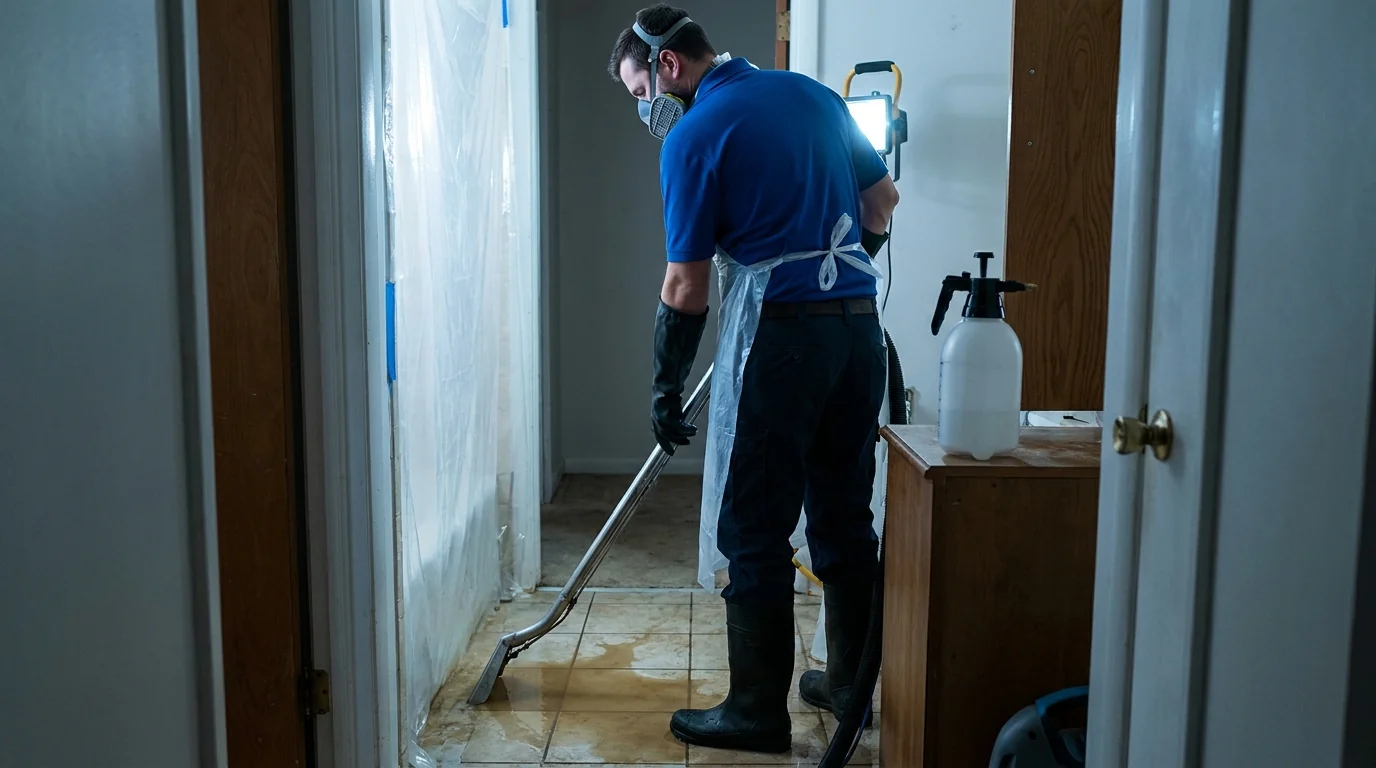
The process on a Dallas job typically moves through these stages:
- Containment and PPE setup — affected areas are isolated before any equipment enters, preventing cross-contamination to unaffected rooms.
- Solid waste and standing water removal — truck-mounted extraction pulls the bulk of contaminated water; solids are bagged and disposed of per Texas Commission on Environmental Quality (TCEQ) guidelines for biohazardous waste.
- Removal of unsalvageable materials — porous materials that absorbed sewage (drywall, insulation, carpet, pad) are removed. In Kessler Park’s older homes, this sometimes includes original hardwood subfloor sections where contamination has wicked into the wood grain.
- Antimicrobial treatment — affected framing, concrete, and hard surfaces are treated with EPA-registered disinfectants rated for sewage contamination. This is applied in multiple passes, not a single spray-and-wipe.
- Drying and documentation — once sanitized, structural drying begins with commercial dehumidifiers and air movers. Moisture readings are logged daily until the structure reaches dry standard, giving your insurance adjuster a defensible record.
Reaching Dallas from Duncanville
The Duncanville base sits directly south of Dallas, which puts MCC crews on a short run up Highway 67 or I-35E to reach Oak Cliff, the Bishop Arts District, Red Bird, and Kiest Park-area addresses without fighting cross-city traffic. For properties closer to Mountain Creek or Dallas Executive Airport, the western approach along Camp Wisdom Road or Wheatland Road keeps drive time minimal. When you call (682) 772-9123, the dispatcher can give you a realistic arrival window based on current conditions — no vague promises.
Dallas Insurance and HOA Coordination
Sewage backups in Dallas frequently involve a coverage question that trips homeowners up: standard homeowners policies often exclude sewer backup unless a rider was added at purchase. MCC documents the loss thoroughly — photographs of affected materials before removal, moisture mapping, waste disposal receipts — so your adjuster has everything needed to evaluate the claim accurately. For multifamily properties along the I-35E corridor or HOA-governed communities in the 75232 and 75233 ZIP codes, we can communicate directly with property managers or HOA boards to coordinate access, document common-area damage separately from unit damage, and meet any board-required sign-off before work begins.
Local Note
One thing that catches homeowners in Kessler Park off guard: the original cast-iron drain stacks in those 1930s and 1940s homes are often embedded in interior walls that were plastered, not drywalled. When sewage backs up through a floor drain and wicks into the wall cavity, the plaster face can look completely dry while the wood lath and framing behind it are saturated. Thermal imaging and deep-probe moisture meters are the only reliable way to find the extent of contamination in those walls — a visual inspection alone will miss it, and leaving contaminated framing in place creates a mold and odor problem that surfaces weeks later.
If you are dealing with a sewage backup anywhere in Dallas — whether it is a single bathroom in a Kessler Park bungalow or a ground-floor commercial space near the Dallas Zoo — call MCC Restoration and Contracting Services at (682) 772-9123. The sooner contaminated material is removed and surfaces are properly sanitized, the narrower the scope of the repair that follows.
Sewage Cleanup and Sanitization in Dallas: Service Coverage
Frequently Asked Questions
Are homes in Kessler Park and Oak Cliff more prone to sewage backups than newer Dallas construction?
How quickly can MCC reach the Red Bird or Kiest Park area from Duncanville?
Does Dallas's spring storm season affect how sewage backups happen and how they're cleaned up?
What does the sanitization process actually involve — is it just spraying bleach?
My Dallas homeowners policy may not cover sewer backup — does that affect what MCC can do?
Sewage Cleanup and Sanitization in Dallas
Our crews are based in Duncanville, TX and take on projects across Dallas. Call for a free estimate.