
Water Damage Restoration in DeSoto
Water damage restoration in DeSoto, TX. Insurance billing accepted. Call (682) 772-9123.
Our crews are dispatched from our Duncanville, TX headquarters and respond quickly to projects across DeSoto.
DeSoto’s expansive clay soil shifts with every rain cycle, and the 1970s–1990s brick homes throughout Thorntree and Windmill Hill carry decades of aging supply lines, water heaters, and slab penetrations that were never designed to outlast a Texas storm season. When one of those components fails — or when a spring storm drives water through a compromised roof — you’re dealing with standing water on slab flooring, saturated drywall, and a clock that starts ticking the moment moisture contacts your framing. MCC Restoration and Contracting Services is based in nearby Duncanville and responds to water damage calls across DeSoto’s 75115 ZIP code.
Why DeSoto Properties See Water Damage More Than You’d Expect
The same mature trees that give Thorntree Country Club and the Windmill Hill Nature Preserve their character also drop heavy limbs onto roofs during the fast-moving spring storms that roll through the Best Southwest corridor every April and May. The April 2022 hailstorm alone left dozens of DeSoto homeowners with cracked roof decks and compromised flashing — entry points that don’t announce themselves until the next hard rain soaks the attic insulation and works its way into ceiling drywall.
Below grade, DeSoto’s expansive clay is relentless. It swells when wet and contracts when dry, and that constant movement stresses slab plumbing year-round. A pinhole in a hot-water line under a slab can run undetected for weeks, quietly saturating the subfloor before the homeowner notices a warm spot underfoot or a spike in the water bill. Homes built in the 1980s along the Hampton Road corridor are especially susceptible — galvanized supply lines in that era are now well past their rated service life, and water heaters in those same homes are often original or first-replacement units pushing 15–20 years.
Our Water Damage Restoration Process in DeSoto
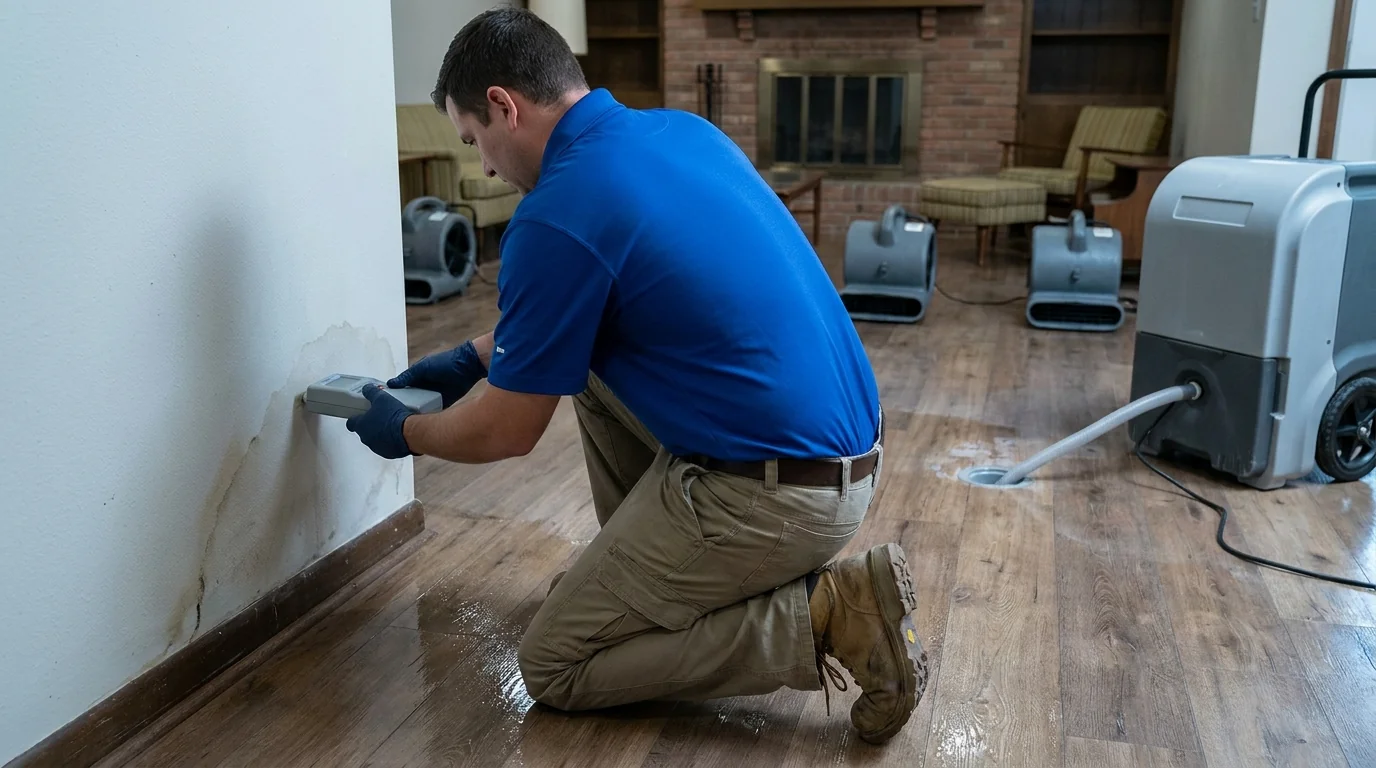
Every job starts with a moisture mapping inspection — thermal imaging and calibrated moisture meters across walls, floors, and ceilings to find water that has migrated beyond the visible damage zone. In DeSoto’s older brick homes, water frequently travels farther than it appears: it follows the mortar bed under tile, wicks into the bottom plate of interior walls, and pools inside the air-gap between the brick veneer and the wood-frame sheathing.
Once the scope is mapped, we extract standing water with truck-mounted and portable extraction units, then set a calculated drying system — industrial air movers and low-grain refrigerant dehumidifiers positioned to create directional airflow through the affected structure. Drying targets are set to IICRC S500 standards for structural drying, and we monitor moisture readings daily until every reading returns to baseline. We document everything — photos, moisture logs, equipment placement records — because your insurance adjuster will need that data.
Demolition is limited to what’s necessary. We don’t tear out materials that can be dried in place, but we don’t leave wet materials behind either. In Meadow Creek and similar neighborhoods where homes have original hardwood under carpet, we assess whether the floor can be dried from above or whether the carpet and pad need to come up to save the wood beneath.
Getting to DeSoto from Our Duncanville Base
MCC Restoration is headquartered in Duncanville, which puts us just minutes from DeSoto’s western neighborhoods via Belt Line Road or US-67. Thorntree and Windmill Hill are straightforward runs from our shop — no toll roads, no major interchange delays under normal conditions. When you call (682) 772-9123, you’ll speak with someone who knows the area, not a national call center routing your job to whoever is available.
DeSoto Insurance Coordination
Most homeowner policies in DeSoto cover sudden and accidental water damage — a burst pipe, a failed water heater, storm-driven roof intrusion. What they typically don’t cover is gradual leakage, so if a slow slab leak has been running for months, expect a coverage conversation. We document the loss thoroughly from the first hour on-site: photos of the source, moisture readings at each affected material, and a written scope that aligns with the format most Texas adjusters expect. We work directly with your carrier and can communicate with your adjuster so you’re not translating between two parties who speak different languages.
Local Note
In DeSoto’s brick-veneer homes — particularly the larger lots in Thorntree — the cavity between the exterior brick and the wood-frame wall is a hidden moisture trap that most restoration crews miss. When storm water or a roof leak saturates the top of that cavity, it can drain down inside the wall for six to eight feet before it ever shows up on a moisture meter reading taken from the interior drywall surface. We probe the weep holes at the base of the brick and use wall-cavity sensors to confirm whether that space is holding moisture before we close out the drying phase. Skipping that step is how a job gets signed off as dry and then shows mold three weeks later.
If water has reached your floors, walls, or ceiling anywhere in DeSoto — whether you’re near Zeiger Park or off the Hampton Road corridor — call MCC Restoration at (682) 772-9123. The sooner the extraction and drying equipment is running, the smaller the final scope of damage.
Water Damage Restoration in DeSoto: Service Coverage
Frequently Asked Questions
How quickly can MCC Restoration reach homes in Thorntree or Windmill Hill after a water damage call?
DeSoto's clay soil causes a lot of slab movement — how does that affect water damage restoration in homes with slab plumbing leaks?
Are older homes along the Hampton Road corridor at higher risk for water heater floods, and what does that kind of loss typically involve?
Does DeSoto have any local code or permit requirements that affect water damage repair work?
How long does the structural drying process take in a typical DeSoto brick home after a significant water loss?
Water Damage Restoration in DeSoto
Our crews are based in Duncanville, TX and take on projects across DeSoto. Call for a free estimate.