Mold Remediation in Duncanville
Mold remediation in Duncanville, TX. Insurance billing accepted. Call (682) 772-9123.
Our crews are headquartered right here in Duncanville and take on projects across the surrounding area.
Duncanville’s Blackland Prairie clay is relentless. Every wet season, that expansive soil shifts beneath the 1950s–1980s brick ranches that line streets from Swan Ridge to the Wheatland Road corridor, stressing slab foundations and the supply lines running through them. When a slow slab leak goes undetected for even a few days in a North Texas summer — where indoor humidity can spike above 70% — mold colonies can establish themselves inside wall cavities and under flooring before a homeowner notices the smell. MCC Restoration and Contracting Services is based right here in Duncanville and handles mold remediation jobs across the city, from initial containment through final clearance.
Why Duncanville Properties See Mold Problems
Three converging factors make mold a recurring issue in Duncanville specifically. First, the housing stock: a large share of homes in ZIP code 75116 were built between 1955 and 1985, when vapor barriers and subfloor ventilation standards were far less rigorous than today. Moisture that enters through a cracked slab or a slow supply-line drip has nowhere to escape, and it migrates into OSB subfloor, fiberglass batt insulation, and drywall paper — all ideal mold substrates.
Second, the climate cycle. Spring hail — Duncanville sits squarely in North Texas hail alley — punches through roof decking and attic insulation. A compromised roof that goes unpatched through a rainy April can deliver enough moisture into an attic to trigger mold growth on rafters and sheathing within two weeks. Third, hard freeze events like February 2021’s Winter Storm Uri caused burst pipes across the city simultaneously, and many homeowners dried surfaces quickly without fully addressing moisture trapped inside wall assemblies. Those incomplete dry-outs are still surfacing as mold discoveries years later.
Our Mold Remediation Process in Duncanville
Every job starts with a thorough visual inspection and moisture mapping — we use thermal imaging and calibrated moisture meters to trace the water source, not just the visible growth. Skipping that step is how mold comes back six months later.
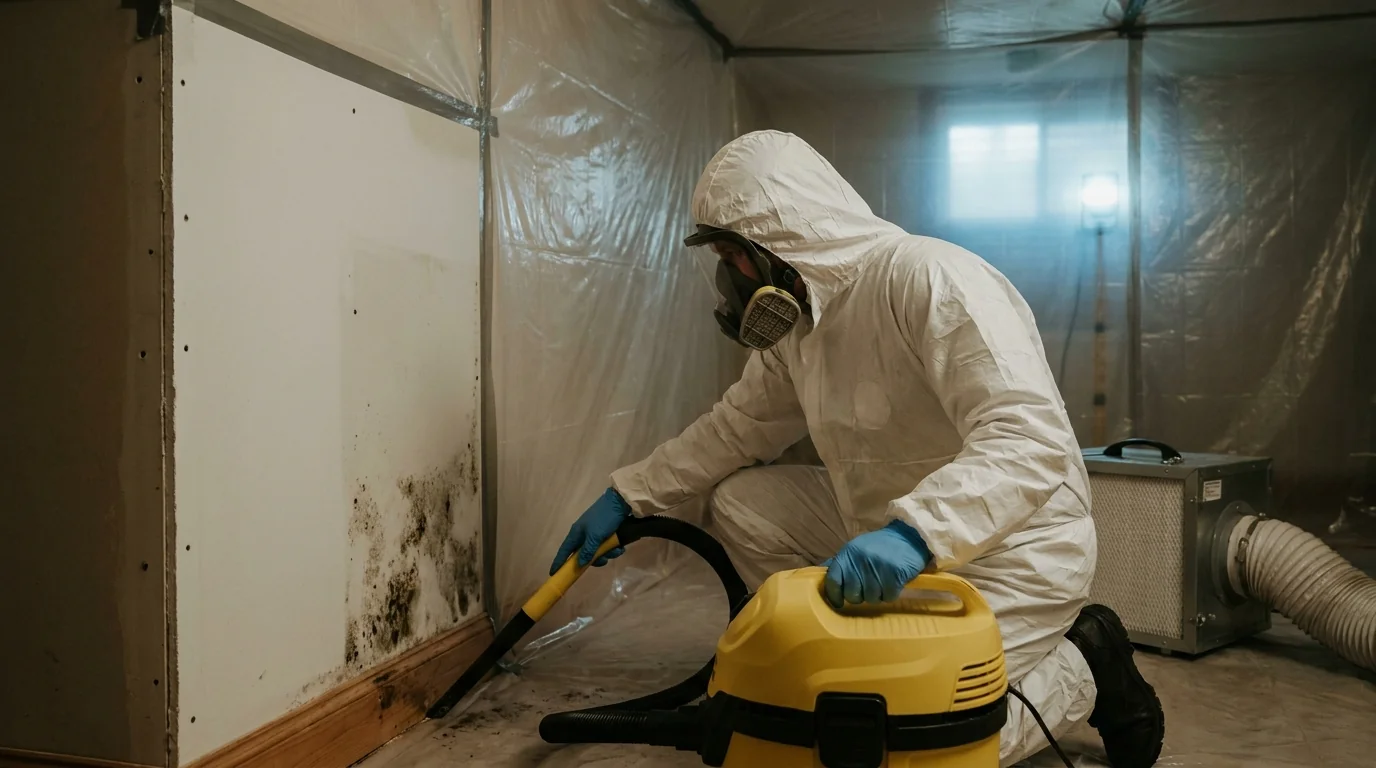
Once we understand the moisture pathway, we establish containment. In the tighter floor plans common to Cedar Ridge and older neighborhoods near Armstrong Park, that typically means negative-air pressure chambers with HEPA-filtered air scrubbers to prevent cross-contamination to adjacent living spaces. We remove and bag affected materials — drywall, insulation, trim — following established remediation protocols, then treat structural surfaces with EPA-registered antimicrobial agents.
Drying comes next. Because Duncanville summers are humid, we run commercial dehumidifiers calibrated to the grain depression needed to bring structural wood down to acceptable moisture content — not just until surfaces feel dry to the touch. After drying is verified with post-remediation moisture readings, the space is ready for reconstruction. MCC handles both sides of that work: remediation and the rebuild, so homeowners deal with one point of contact instead of coordinating two separate contractors.
Duncanville Insurance Coordination
Mold claims in Texas are frequently disputed, and the outcome often depends on documentation quality. We photograph and log every affected material before removal, produce a written scope of work, and can communicate directly with your adjuster throughout the process. Whether the underlying cause is a covered sudden pipe burst or a longer-term leak that your carrier may push back on, having a detailed remediation record strengthens your position.
Homeowners near Duncanville High School and the Main Street district who carry standard HO-3 policies should be aware that Texas policies vary significantly in how they define covered water damage versus gradual seepage — that distinction affects whether mold remediation costs are reimbursable. We can walk you through what documentation your adjuster will likely request before we start work.
Local Note
One pattern we see consistently in Duncanville’s brick ranch homes: the original builders often ran copper supply lines through the slab with minimal protective sleeve material. When those lines develop pinhole leaks — accelerated by the pH of local water and decades of soil movement — the leak wicks horizontally through the sand bed under the slab before it ever surfaces. By the time a homeowner near the Joe Pool Lake vicinity or along the Wheatland Road corridor notices a warm spot on the floor or a spike in their Oncor-metered utility bill, the moisture front may have traveled several feet from the actual leak point. That means mold remediation in these homes sometimes requires opening walls or flooring well beyond the visible damage zone to find and treat the full extent of growth.
If you have had a slab leak repaired but never had the adjacent wall cavities and subfloor inspected for residual moisture, it is worth a call before the next humid summer makes the problem visible — and significantly more expensive.
MCC Restoration and Contracting Services is headquartered in Duncanville and works throughout the city and surrounding Best Southwest communities. If you are seeing discoloration on walls, detecting a musty odor that persists after cleaning, or dealing with the aftermath of a slab leak or burst pipe, call us at (682) 772-9123 to schedule an assessment. We will tell you honestly what we find and what it will take to fix it.
Mold Remediation in Duncanville: Service Coverage
Frequently Asked Questions
Are homes in Duncanville's Swan Ridge and Cedar Ridge neighborhoods more prone to mold after a slab leak?
How does Duncanville's Blackland Prairie clay affect the scope of a mold remediation job?
Homes near Duncanville High School and the Main Street district are older — does that change the remediation process?
What does mold remediation actually involve — is it just spraying something on the surface?
Will my Texas homeowner's insurance cover mold remediation from a burst pipe during a freeze like the 2021 storm?
Mold Remediation in Duncanville
Our crews are based in Duncanville, TX and take on projects across Duncanville. Call for a free estimate.