Mold Remediation in Grand Prairie
Mold remediation in Grand Prairie, TX. Insurance billing accepted. Call (682) 772-9123.
Our crews are dispatched from our Duncanville, TX headquarters and respond quickly to projects across Grand Prairie.
Grand Prairie’s geography tells the whole mold story before you even open a wall: a 25-mile corridor running from aging 1950s neighborhoods near I-30 all the way down to the lakeside developments hugging Joe Pool Lake, all of it sitting in one of the most humid stretches of the DFW Metroplex. When a roof takes hail damage on Lake Ridge Parkway or an upstairs bathroom supply line fails in a Mira Lagos two-story, the moisture doesn’t just dry on its own — in a Texas summer, mold can begin colonizing wet drywall in as little as 24 to 48 hours. MCC Restoration and Contracting Services responds to those calls from our Duncanville base, typically reaching Grand Prairie addresses in well under an hour.
Why Grand Prairie Properties See Mold Problems
The north end of Grand Prairie — Dalworth and the surrounding blocks of 1940s and 1950s construction — presents a different mold risk profile than almost anywhere else in the metro. Galvanized and early copper supply lines in those homes have reached or exceeded their service life, and slow pinhole leaks inside wall cavities can feed mold colonies for months before a homeowner notices discoloration or a musty odor. Insulation in those older walls is often compressed fiberglass batts or even remnant cellulose, both of which hold moisture and give mold an organic food source that modern closed-cell foam does not.
The south end tells a different story. Grand Peninsula, Mira Lagos, and the Lake Parks area are filled with 2000s–2020s two-story homes where finished first floors sit directly below upstairs laundry closets, master bathrooms, and ice-maker lines. When those fail — and in DFW’s hard water environment, supply line braiding corrodes faster than manufacturers’ warranties suggest — water travels silently through floor assemblies and appears as a ceiling stain or buckled laminate days after the actual event. By then, mold is already establishing in the subfloor cavity.
Grand Prairie also sits squarely in the DFW hail corridor. A single spring storm can push wind-driven rain through compromised roof decking, ridge vents, or flashing, saturating attic insulation and the top plates of exterior walls. Those roof-to-wall intrusions are notoriously easy to miss on a visual inspection and are a leading cause of the mold calls we receive in ZIP codes 75052 and 75054.
Our Mold Remediation Process in Grand Prairie
Every job starts with a thorough moisture mapping inspection — thermal imaging and calibrated moisture meters on walls, ceilings, and floors — before any demolition begins. Knowing exactly where moisture is elevated prevents both under-removal (leaving hidden colonies behind) and over-demolition (tearing out dry material unnecessarily).
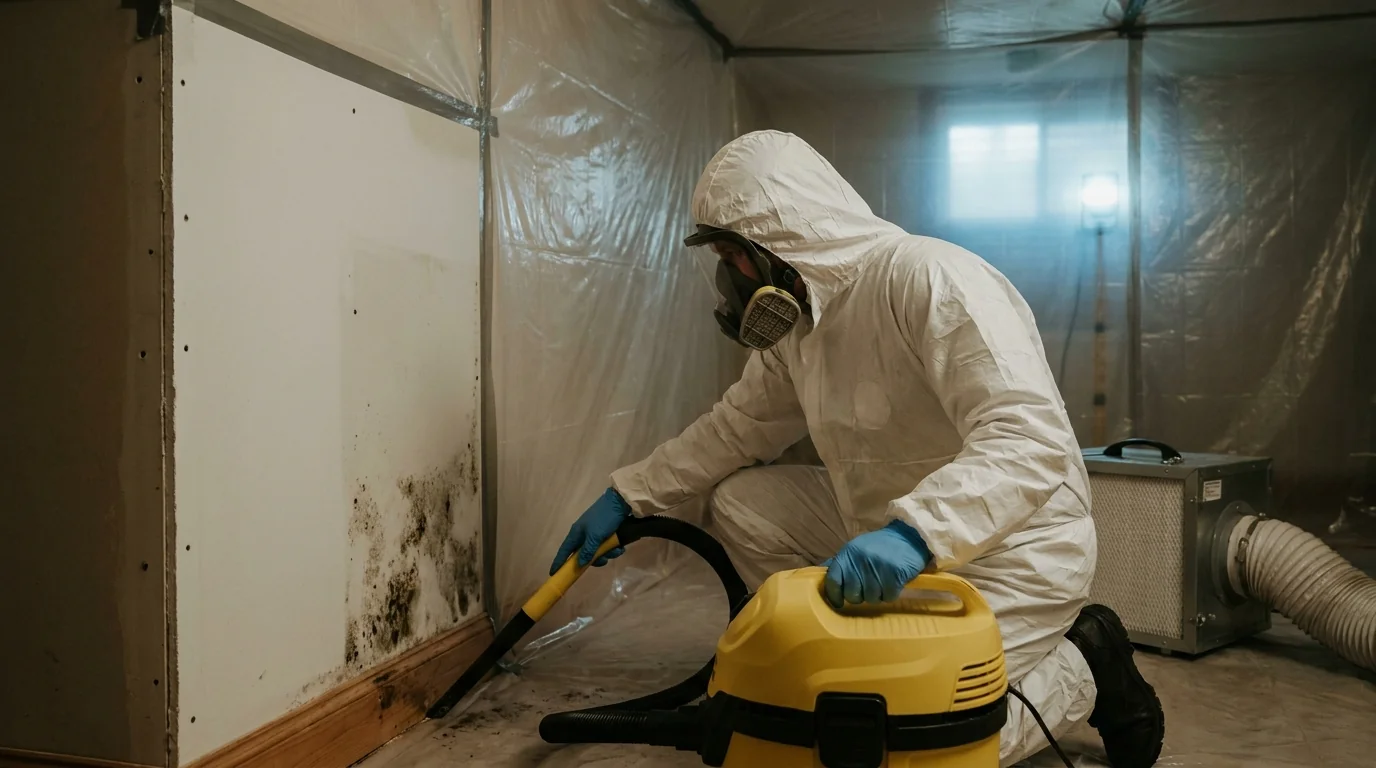
Once the scope is defined, we establish negative-air containment using 6-mil poly barriers and HEPA-filtered air scrubbers. This is especially important in the open floor plans common to south Grand Prairie’s newer construction, where mold spores can travel freely through HVAC returns if containment is not airtight. Affected materials — drywall, insulation, subfloor sections — are removed, bagged, and disposed of per Texas Commission on Environmental Quality guidelines.
After removal, we treat structural framing and remaining surfaces with an EPA-registered antimicrobial, then run commercial desiccant or refrigerant dehumidifiers until moisture readings return to normal dry-standard levels for North Texas. We do not close walls until those readings confirm the cavity is dry — a step that matters more in Grand Prairie’s humid summers than it would in a drier climate.
Reaching Grand Prairie from Duncanville
MCC’s Duncanville location puts us on the southern edge of Grand Prairie’s service area, which means we can reach the Grand Peninsula and Mira Lagos communities quickly via US-67 and FM 1382. Getting to the older Dalworth neighborhood and north Grand Prairie addresses typically means a run up I-20 or Pioneer Parkway — both straightforward routes with no significant chokepoints outside of peak commute hours. When you call (682) 772-9123, we can give you a realistic arrival window based on current conditions rather than a marketing promise.
Grand Prairie Insurance Coordination
Mold remediation claims in Grand Prairie most often originate from a covered water loss — the burst pipe, the failed appliance line, the hail-damaged roof. Whether the mold is a direct extension of that claim or a separate discovery, documentation matters enormously. We photograph and measure all affected areas, log moisture readings with timestamps, and provide itemized scope-of-work reports formatted for adjuster review. We work alongside your carrier’s process; we do not pressure you to sign anything that conflicts with your policy rights.
Local Note
One pattern we see repeatedly in Grand Prairie’s newer lakeside communities — Grand Peninsula and Mira Lagos in particular — is that HOA architectural review requirements can add time to the reconstruction phase after mold remediation. If exterior materials like stucco, stone veneer, or specific roofing profiles need to be replaced as part of the repair, some HOAs require pre-approval of the replacement materials before work begins. We flag this early in the scoping conversation so it does not stall a job that is otherwise ready to close out. If your property falls under an HOA, let us know when you call and we will factor that review window into the project timeline.
If you are seeing visible mold growth, smelling a persistent musty odor, or dealing with the aftermath of a water event anywhere in Grand Prairie, call MCC Restoration and Contracting Services at (682) 772-9123. The longer mold has to spread in a closed wall cavity or under a finished floor, the more material has to come out — getting an assessment scheduled promptly is always the lower-cost path.
Mold Remediation in Grand Prairie: Service Coverage
Frequently Asked Questions
Are older homes in the Dalworth area of Grand Prairie more likely to have hidden mold?
We have a two-story home in Mira Lagos and found mold on our first-floor ceiling — what typically causes that?
How does Grand Prairie's hail season affect mold risk, and what ZIP codes see the most roof-related mold calls?
What does the mold containment process look like inside my home during remediation?
If my mold was caused by a covered water loss, how does MCC handle the insurance documentation?
Mold Remediation in Grand Prairie
Our crews are based in Duncanville, TX and take on projects across Grand Prairie. Call for a free estimate.