Fire Damage Restoration in Grand Prairie
Fire damage restoration in Grand Prairie, TX. Insurance billing accepted. Call (682) 772-9123.
Our crews are dispatched from our Duncanville, TX headquarters and respond quickly to projects across Grand Prairie.
Grand Prairie’s older north-end neighborhoods tell a particular fire story: a kitchen grease fire in a Dalworth home built in the 1950s doesn’t just scorch the cabinets — it drives smoke deep into original plaster walls, travels through uninsulated interior cavities, and leaves soot on surfaces two rooms away before the fire department clears the scene. Whether the call comes from a post-war bungalow near I-30 or a two-story new-build backing up to Joe Pool Lake, the damage pattern is shaped by how the house was built, and that difference matters in how restoration gets done.
Why Grand Prairie Properties See Fire Damage Differently
Grand Prairie stretches roughly 25 miles from its older industrial north end down through fast-growing communities like Grand Peninsula and Mira Lagos near the lake. That geography means two very different housing stocks — and two very different fire damage profiles.
In the Dalworth area and other pre-1960s neighborhoods, homes often have original wood-framed interiors, knob-and-tube or early Romex wiring, and minimal vapor barriers. A fire in these homes tends to produce heavier char penetration into structural members, and the plaster-and-lath wall systems hold odor compounds longer than modern drywall. Smoke doesn’t just coat surfaces — it absorbs into the plaster matrix itself.
In the south end’s 2000s–2020s two-story construction, the fire risk profile shifts. Open floor plans and engineered lumber trusses allow fire and superheated gases to spread faster horizontally. Synthetic materials in flooring, cabinetry, and insulation produce a denser, oilier smoke residue that bonds to HVAC ductwork and requires chemical sponging rather than simple vacuuming. North Texas’s climate adds another layer: summer attic temperatures regularly exceed 140°F, which accelerates off-gassing of smoke residue trapped in insulation long after the visible fire is out.
Our Fire Damage Restoration Process in Grand Prairie
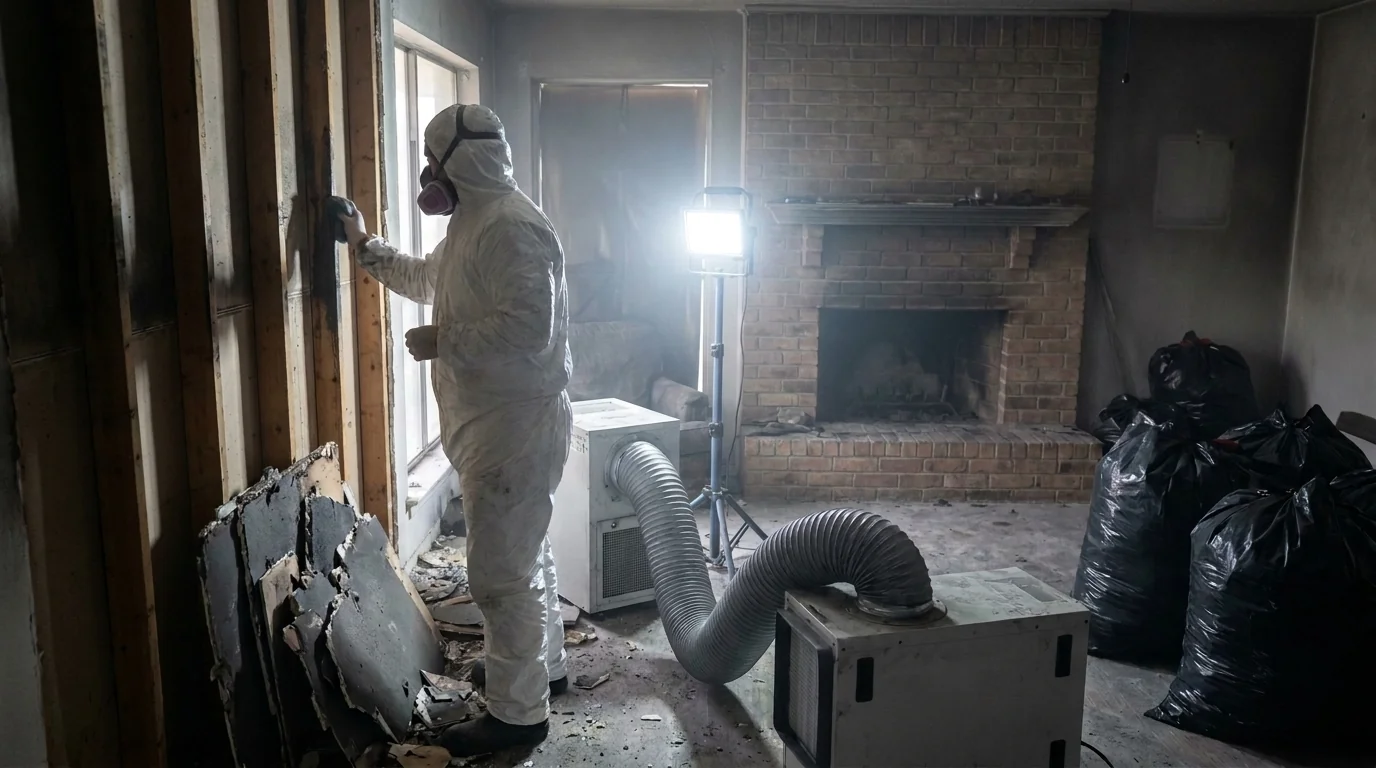
Every fire job starts with a systematic damage assessment before any cleaning or demolition begins. That means documenting char depth on structural members, mapping smoke migration through the HVAC system, and identifying which materials are salvageable versus which need removal — a distinction that directly affects your insurance claim.
Once the scope is confirmed, the work moves in a deliberate sequence:
- Emergency board-up and tarping to secure the structure against weather and unauthorized entry
- Debris removal and selective demolition of unsalvageable materials, down to clean framing where required
- Dry ice blasting or chemical sponging of smoke-affected surfaces, chosen based on the material — porous plaster in older homes responds differently than painted drywall or exposed OSB
- Thermal fogging and hydroxyl treatment to neutralize odor compounds embedded in cavities and soft materials
- Structural drying if firefighting water is present, coordinated with smoke remediation rather than run as a separate phase
- Full reconstruction of affected areas, from framing through finish work, handled in-house rather than handed off to a separate contractor
Documentation runs through every phase — photos, moisture readings, and material logs that support your insurance adjuster’s review.
Reaching Grand Prairie from Duncanville
MCC Restoration and Contracting Services is based in Duncanville, which sits directly adjacent to Grand Prairie’s western boundary. From the shop, the fastest routes into the city follow US-67 or I-20 east, putting crews into the Westchester corridor and the neighborhoods along Lake Ridge Parkway without navigating through downtown Dallas traffic. The south end — Grand Peninsula, Mira Lagos, and the communities closest to Joe Pool Lake — is accessible via FM 1382 or Lakeridge Parkway, typically a straightforward drive from Duncanville even during peak hours.
For properties in ZIP codes 75052 and 75054, which cover much of the newer south-end development, the Duncanville location is genuinely close — not a marketing claim, just geography. Call (682) 772-9123 to schedule a prompt assessment.
Grand Prairie Insurance Coordination
Fire claims in Grand Prairie follow the same carrier landscape as the broader DFW market — State Farm, Allstate, USAA, Farmers, and a range of independent carriers all have active policyholders here. What varies is how well the initial documentation supports the claim. Adjusters working fire losses want to see scope-of-damage reports that distinguish between primary fire damage, secondary smoke damage, and water damage from suppression — because each can be coded differently on the claim.
MCC documents all three damage types from the first site visit, photographs structural conditions before any demolition, and provides itemized material lists that align with Xactimate line items. That preparation reduces the back-and-forth that slows claim approval and gets reconstruction started faster.
Local Note
In Grand Prairie’s older Dalworth-area homes, fire investigators and restoration crews occasionally encounter asbestos-containing materials in floor tile, pipe insulation, or textured ceiling coatings — products common in construction from the 1940s through the early 1980s. A fire that disturbs these materials changes the remediation sequence: asbestos-containing debris must be handled and disposed of under Texas DSHS rules before standard fire cleanup proceeds. If your home was built before 1985 and has sustained structural fire damage, it’s worth flagging this possibility before demolition begins — not to create alarm, but because discovering it mid-job causes delays and additional cost that a quick pre-demo check can avoid.
Fire damage doesn’t wait for a convenient time, and the longer smoke residue sits in walls and ductwork, the harder it is to fully remove. If you’re dealing with fire or smoke damage anywhere in Grand Prairie — from the north-end neighborhoods near I-30 to the newer communities along Joe Pool Lake — call MCC Restoration and Contracting Services at (682) 772-9123 to get an assessment scheduled and the restoration process moving.
Fire Damage Restoration in Grand Prairie: Service Coverage
Frequently Asked Questions
Do older Dalworth-area homes in Grand Prairie require a different fire restoration approach than newer construction?
How does Grand Prairie's hot climate affect smoke odor after a fire?
Can MCC handle both the fire cleanup and the full rebuild for a Grand Peninsula or Mira Lagos home?
What documentation does MCC provide to support a fire insurance claim in Grand Prairie?
Should I be concerned about asbestos in a fire-damaged Grand Prairie home built before 1985?
Fire Damage Restoration in Grand Prairie
Our crews are based in Duncanville, TX and take on projects across Grand Prairie. Call for a free estimate.