Flood Damage Restoration in Grand Prairie
Flood damage restoration in Grand Prairie, TX. Insurance billing accepted. Call (682) 772-9123.
Our crews are dispatched from our Duncanville, TX headquarters and respond quickly to projects across Grand Prairie.
Grand Prairie sits in one of the most flood-active corridors in North Texas, where spring thunderstorms can drop three inches of rain in under an hour and leave standing water inside homes from Dalworth to the Grand Peninsula before the storm even clears the radar. When that happens — water wicking into baseboards, soaking subflooring, or sheeting down a finished first-floor ceiling because an upstairs bathroom overflowed — the clock starts immediately. MCC Restoration and Contracting Services operates out of nearby Duncanville and responds to flood damage calls across Grand Prairie, working to stop the spread and start the drying process before secondary damage compounds the loss.
Why Grand Prairie Properties See Flood Damage Differently
Grand Prairie stretches roughly 25 miles from the older neighborhoods near I-30 down to the Joe Pool Lake shoreline, and the housing stock on each end fails in distinctly different ways. In the north — Dalworth and similar mid-century communities built in the 1940s through 1960s — galvanized supply lines and cast-iron drain stacks are reaching the end of their service life. A pipe that holds through a mild winter can split during a hard freeze or simply corrode through, releasing water inside wall cavities that have no moisture barrier at all. Older slab foundations in these neighborhoods also tend to have settled unevenly over decades, which means water doesn’t drain away from the structure the way it should.
On the south end, the story is different. Communities like Grand Peninsula and Mira Lagos are largely 2000s-to-2020s two-story construction, and the failure pattern there is almost always upstairs — a refrigerator ice-maker line, a second-floor laundry connection, or a master bath supply that lets go overnight. Water travels fast through open-concept floor plans, soaks engineered hardwood and LVP flooring, and saturates the insulation above finished ceilings before anyone notices. Both ends of the city require flood cleanup, but the materials, the drying strategy, and the reconstruction scope are rarely the same job.
Grand Prairie also sits squarely in the DFW hail corridor. A severe hail event that punches through roof decking or knocks loose flashing around a chimney or skylight can let rainwater infiltrate an attic for weeks before the interior staining makes it obvious. Those slow-leak situations are often more damaging than a single flood event because the framing and insulation absorb moisture over a long period.
Our Flood Damage Restoration Process in Grand Prairie
Every flood job starts with a thorough moisture assessment — not just the visible wet area, but the surrounding materials. Moisture meters and thermal imaging help locate water that has traveled behind walls or under flooring well beyond the obvious damage zone. That step matters especially in older Dalworth-area homes where plaster-over-lath construction holds water differently than modern drywall, and in south Grand Prairie two-stories where water can travel along joists and pool in unexpected corners of the floor below.
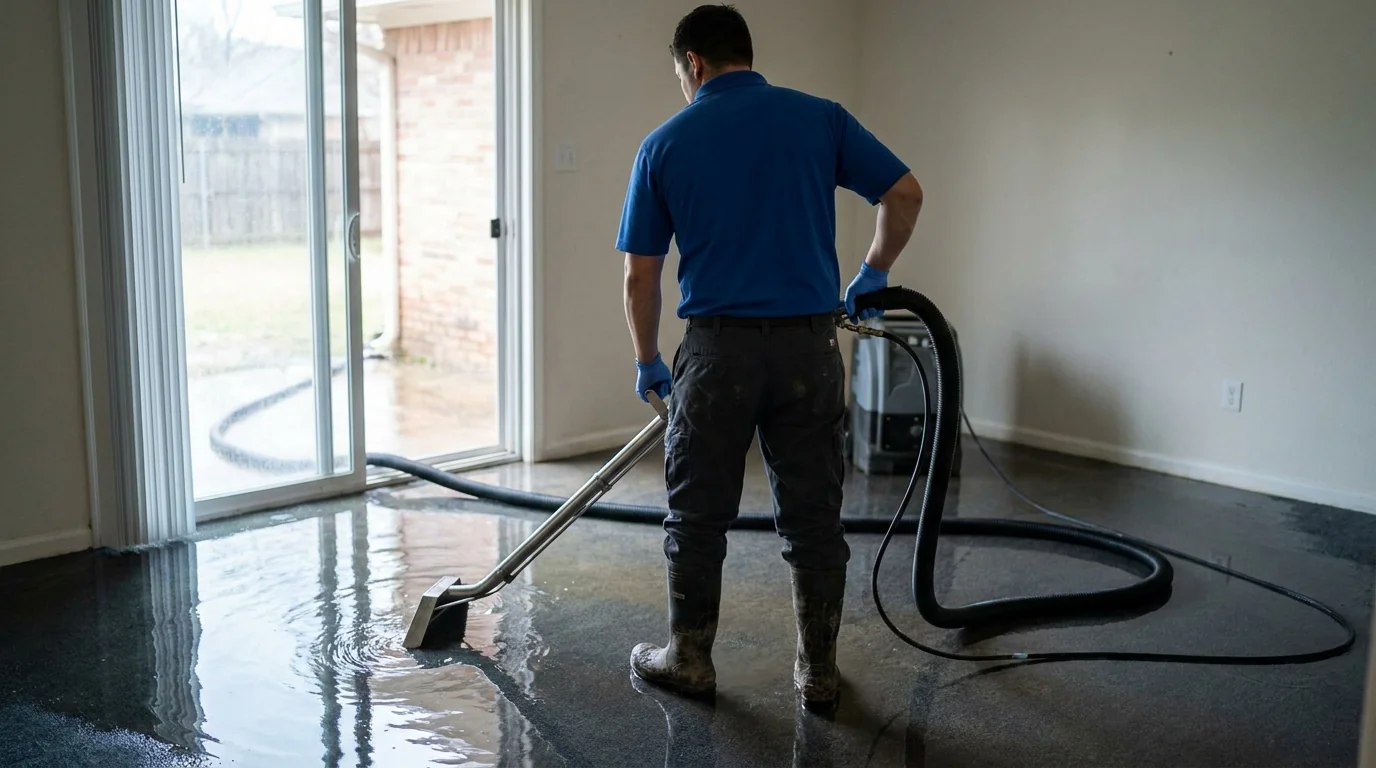
Once the scope is mapped, the process moves to extraction, controlled demolition of unsalvageable materials, and structured drying using commercial-grade air movers and dehumidifiers calibrated to the square footage and material types involved. Drying is documented with daily moisture readings so there’s a clear record for your insurance adjuster. After the structure reaches dry standard, MCC handles the reconstruction side — flooring, drywall, cabinetry, painting — so you’re not coordinating a separate contractor for the rebuild.
Reaching Grand Prairie from Duncanville
MCC’s base in Duncanville puts the team within practical reach of Grand Prairie via I-20 or Highway 67, with straightforward access to both the northern neighborhoods along Carrier Parkway and the southern communities near Lake Ridge Parkway and Joe Pool Lake. For properties in ZIP codes 75050 and 75051 — the older north end of the city — the route via I-20 East is typically direct. South Grand Prairie addresses in 75052 and 75054 are accessible via Highway 360 or Carrier Parkway south. Call (682) 772-9123 to confirm scheduling and get a technician dispatched to your address.
Grand Prairie Insurance Coordination
Flood and water damage claims in Grand Prairie follow standard Texas homeowner’s insurance procedures, but the documentation requirements matter. Adjusters want moisture logs, photos of affected materials before demolition, and a clear scope of work. MCC documents the loss from the first visit — moisture readings, photographs, material identification — and provides that file directly to your carrier. If your policy involves a separate flood insurance component through the NFIP, the documentation requirements are more detailed, and we’re familiar with what those adjusters need to process a claim efficiently.
Local Note
In Grand Prairie’s south-end communities — particularly the two-story homes in Grand Peninsula and Mira Lagos — HOA architectural guidelines sometimes govern exterior work like roof repairs or visible reconstruction staging. If your flood loss involves storm-related roof damage that feeds interior water damage, it’s worth checking your HOA’s approval process before scheduling exterior repairs, since some associations require submitted plans even for like-for-like replacements. MCC can document the damage scope in a format that supports both your insurance claim and any HOA approval submission, which prevents the frustrating situation of completing interior restoration only to have the exterior repair stalled.
If your Grand Prairie home has taken on water — whether from a burst pipe in an aging north-end neighborhood, a second-floor appliance failure in a newer south-end build, or storm-driven roof infiltration — call MCC Restoration and Contracting Services at (682) 772-9123. The sooner extraction and drying begin, the smaller the reconstruction scope tends to be.
Flood Damage Restoration in Grand Prairie: Service Coverage
Frequently Asked Questions
How quickly can MCC reach a flood damage call in south Grand Prairie near Mira Lagos or Grand Peninsula?
Are older homes in the Dalworth area more difficult to dry out after a flood?
My upstairs bathroom flooded and water came through the first-floor ceiling — is that a common pattern in Grand Prairie's newer two-story homes?
Does Grand Prairie's location in the DFW hail corridor affect how flood damage restoration jobs are scoped?
Will MCC handle both the water damage restoration and the reconstruction, or do I need to hire a separate contractor in Grand Prairie?
Flood Damage Restoration in Grand Prairie
Our crews are based in Duncanville, TX and take on projects across Grand Prairie. Call for a free estimate.