Flood Damage Restoration in Dallas
Flood damage restoration in Dallas, TX. Insurance billing accepted. Call (682) 772-9123.
Our crews are dispatched from our Duncanville, TX headquarters and respond quickly to projects across Dallas.
When a spring supercell drops three inches of rain on southern Dallas in under an hour, the Trinity River bottoms and the creek-adjacent streets feeding into Mountain Creek Lake don’t drain fast enough — and the water has to go somewhere. For homeowners in Oak Cliff, Red Bird, and the Kessler Park corridor, that somewhere is often a crawl space, a finished basement, or the first floor of a 1940s bungalow that was never designed to shed a flash-flood event. MCC Restoration and Contracting Services operates out of Duncanville, which puts us minutes from the ZIP codes — 75211, 75233, 75237 — where these calls come in most often.
Why Dallas Properties See Flood Damage Differently Than Most Cities
Dallas sits on expansive black clay soil — the kind that swells when wet and shrinks when dry, creating a constant shifting cycle beneath foundations. That movement cracks slab foundations and separates drain lines from their fittings over time. In Kessler Park and the older streets near the Bishop Arts District, homes built between the 1920s and 1950s still run on original cast-iron drain stacks and galvanized supply lines. Those materials corrode from the inside out, and a single pressure surge during a storm event can open a joint that has been quietly failing for years. The result looks like a flood — and functionally it is — but the source is internal, not the sky.
Further south, the 1970s and 1980s tract homes in Red Bird and Mountain Creek were built to the codes of their era: slab-on-grade construction, minimal crawl-space ventilation, and HVAC systems tucked into tight closets or attic chases. When water enters those structures, it travels fast through the slab interface and wicks into wall cavities before a homeowner realizes the floor is wet. By 24 to 48 hours, conditions are right for secondary microbial growth — which is why extraction speed matters more than almost anything else in a Dallas flood loss.
Our Flood Damage Restoration Process in Dallas
Every flood job starts with a thorough moisture mapping of the structure before a single piece of equipment is placed. We use thermal imaging alongside pin and pinless moisture meters to trace where water has migrated — not just where it’s visible. In older Oak Cliff homes with original hardwood floors over a wood subfloor, water often travels six to eight feet laterally from the point of entry before showing any surface sign.
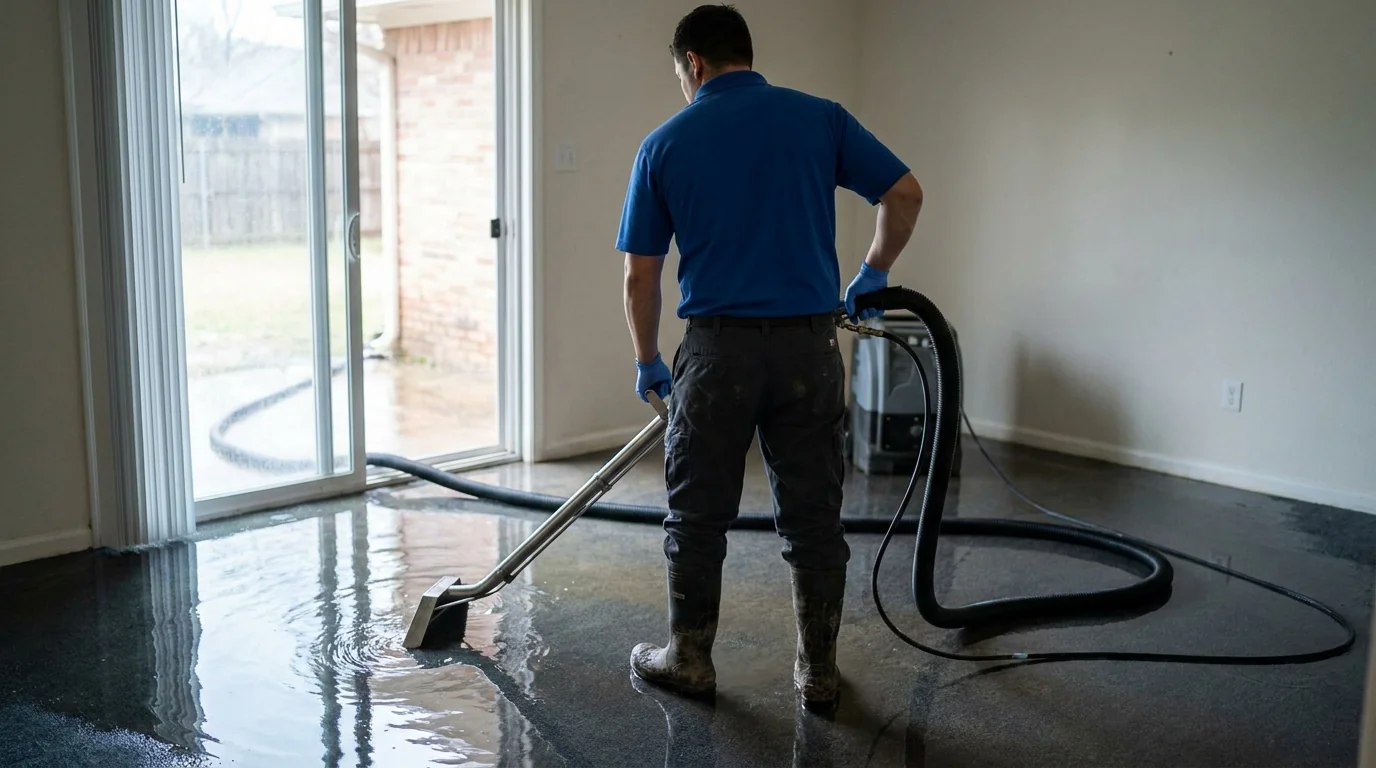
Once the scope is documented, extraction comes first: truck-mounted and portable units pull standing water and saturated material out of carpet, pad, and subfloor assemblies. We then establish a drying system calibrated to the actual square footage and material types in the structure — commercial-grade dehumidifiers and high-velocity air movers positioned according to a drying plan, not just placed at random. Readings are logged at each visit so the drying curve is documented for your insurance adjuster. Affected drywall, insulation, and flooring that cannot be dried in place are removed to the flood cut line, and the structure is treated before enclosure.
Reaching Dallas from Our Duncanville Base
Duncanville sits directly south of Dallas along Highway 67, which feeds into the heart of the ZIP codes we serve most — 75237 near the Dallas Executive Airport corridor, 75232 through Red Bird, and 75211 into Oak Cliff and the streets around Kiest Park. We know these routes because we run them regularly, not just when a call comes in. That familiarity matters when you’re navigating I-35E construction delays or the surface-street grid around the Methodist Dallas Medical Center area during peak hours.
Dallas Insurance Coordination
Flood losses in Dallas frequently involve both a homeowner’s policy and, if the property sits in a FEMA-designated flood zone near the Trinity River Greenbelt, a separate National Flood Insurance Program (NFIP) claim. Those two claims run on different documentation requirements and different adjuster timelines. We photograph and document affected materials before removal, produce moisture logs that meet adjuster standards, and communicate directly with your claims representative so you’re not translating between the field and the insurance office. We bill carriers directly on most residential losses.
Local Note
One thing that catches homeowners off guard in Kessler Park and the historic blocks near the Dallas Zoo: original plaster-and-lath walls hold moisture very differently than modern drywall. Plaster is denser and releases water slowly — drying a plaster wall to acceptable moisture content can take 40 to 60 percent longer than a comparable drywall assembly. If a restoration crew sets equipment for a standard drying schedule and pulls out on day three, there’s a real chance the plaster is still holding moisture behind the surface. We extend monitoring cycles on pre-1950 construction and adjust the drying plan accordingly rather than declaring a job complete by the calendar.
If your Dallas home or property has taken on water — whether from a flash-flood event along a creek-adjacent street, a failed drain line in an older Oak Cliff bungalow, or storm-driven water intrusion — call MCC Restoration and Contracting Services at (682) 772-9123. We’ll assess the damage, document it properly, and get the drying process started before the clock works against you.
Flood Damage Restoration in Dallas: Service Coverage
Frequently Asked Questions
How quickly can MCC reach Oak Cliff or Kessler Park after a flood call?
Does Dallas's expansive clay soil affect how flood damage is assessed or repaired?
Are the older homes near the Bishop Arts District and Kessler Park harder to dry after a flood?
What's the difference between a homeowner's policy claim and an NFIP claim for Dallas flood damage?
How long does flood damage restoration typically take for a single-family home in Red Bird or Mountain Creek?
Flood Damage Restoration in Dallas
Our crews are based in Duncanville, TX and take on projects across Dallas. Call for a free estimate.