Flood Damage Restoration in Cedar Hill
Flood damage restoration in Cedar Hill, TX. Insurance billing accepted. Call (682) 772-9123.
Our crews are dispatched from our Duncanville, TX headquarters and respond quickly to projects across Cedar Hill.
When heavy rain rolls across Joe Pool Lake and funnels down Cedar Hill’s escarpment slopes, water doesn’t just pool — it moves fast, carrying sediment and pressure into foundations, crawl spaces, and lower-level living areas before most homeowners realize what’s happening. The same elevation that gives Cedar Hill some of the most dramatic views in the Dallas–Fort Worth Metroplex also concentrates runoff in ways that flat suburban lots simply don’t experience. MCC Restoration and Contracting Services, based in nearby Duncanville, responds to flood damage across Cedar Hill’s 75104 and 75106 ZIP codes — from Lake Ridge’s hillside custom homes to the older structures near historic downtown.
Why Cedar Hill Properties See Flood Damage Differently
Cedar Hill sits atop the White Rock Escarpment, and that geology shapes every flood loss in town. The heavy clay soils that define the escarpment expand when wet and contract when dry, which keeps foundations — and the plumbing running through them — in constant slow motion. A pipe that was perfectly seated last spring may have shifted enough by fall to fail under the pressure of a storm surge. In Lake Ridge, where many of the custom homes were built on graded slopes during the early 2000s, drainage systems were designed for average rainfall events, not the 4- to 6-inch deluges that North Texas increasingly sees in a single afternoon. When those systems back up, water intrusion typically enters through garage slabs, window wells, and the lower courses of exterior walls — often reaching finished living space within minutes.
Historic downtown Cedar Hill presents a different set of challenges. Structures there may carry older cast-iron or galvanized supply lines that have already been stressed by decades of foundation movement. A flood event in one of those buildings isn’t just a surface-water problem — it’s frequently the trigger that exposes a pre-existing pipe failure that was quietly seeping behind plaster or original hardwood flooring.
Our Flood Damage Restoration Process in Cedar Hill
Every flood loss is different, but the sequence of decisions matters enormously. When we arrive at a Cedar Hill property, the first priority is moisture mapping — using thermal imaging and calibrated moisture meters to trace exactly where water has traveled, including into wall cavities, subfloor assemblies, and HVAC chases. Standing water visible on the floor is rarely the full story; in slab-on-grade homes common throughout Cedar Hill, water wicks laterally under flooring and into adjacent rooms well beyond the visible wet zone.
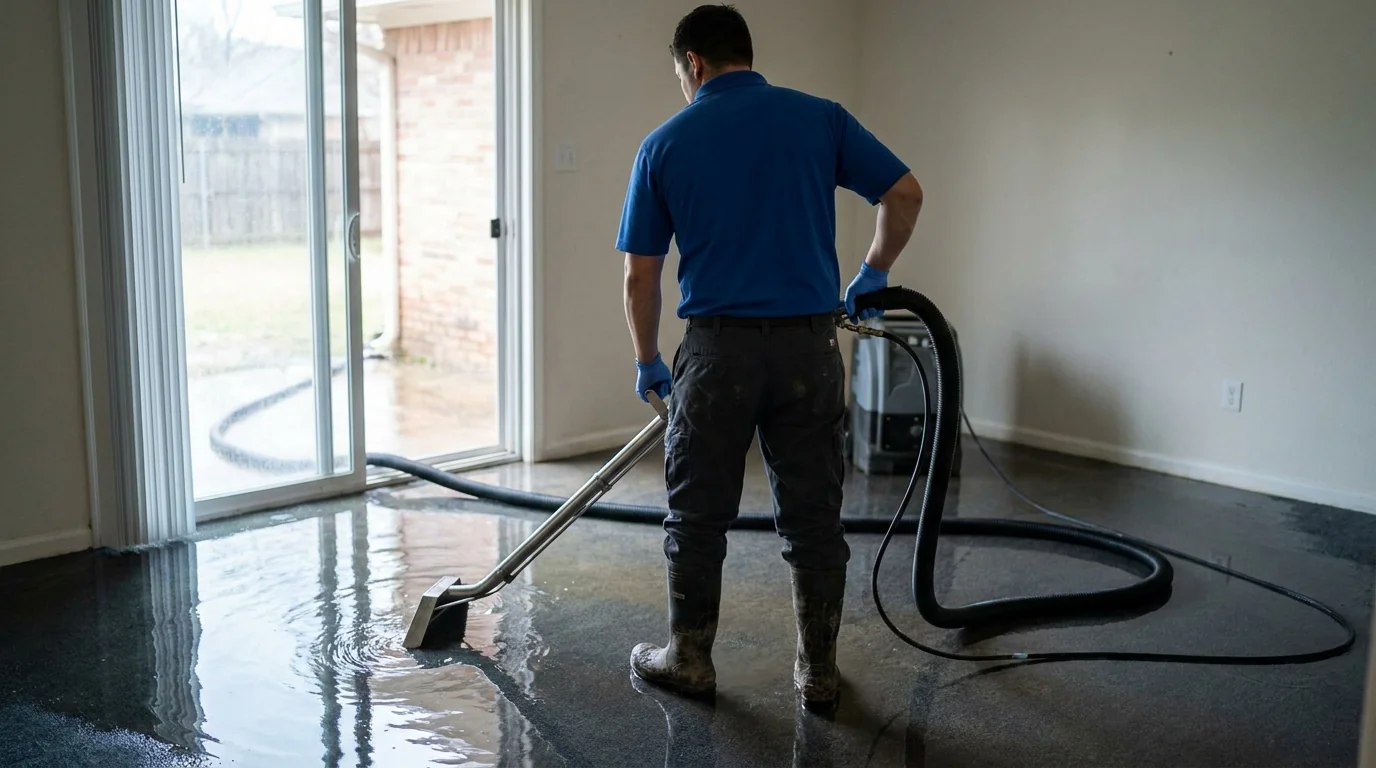
Once the scope is documented, we extract standing water, then establish a structured drying system using commercial-grade air movers and dehumidifiers sized to the affected square footage. Drying targets are set and monitored daily — we don’t pull equipment based on a calendar, we pull it when psychrometric readings confirm the materials have reached acceptable moisture content. Any building materials that cannot be dried in place — saturated insulation, buckled flooring, compromised drywall — are removed and documented for your insurance claim before disposal.
Reaching Cedar Hill from Duncanville
Our Duncanville location puts us roughly 10 to 15 minutes from most Cedar Hill addresses under normal traffic conditions via US-67. Lake Ridge and the neighborhoods along Straus Road near Cedar Hill State Park are a straightforward run south on 67 and then west — we know those roads well and travel them regularly. For properties in the Bear Creek area or closer to Uptown Village at Cedar Hill, we typically approach via FM 1382 depending on time of day and road conditions. When you call (682) 772-9123, we’ll give you an honest arrival estimate based on where our crew is at that moment rather than a marketing number.
Cedar Hill Insurance Coordination
Flood losses in Cedar Hill frequently involve both homeowners insurance and, for properties in designated flood zones near Joe Pool Lake, separate National Flood Insurance Program (NFIP) policies. These two coverages have different documentation requirements, different adjusters, and different timelines — and mixing them up early in the claim process can delay payment significantly. We photograph affected materials in place before any removal, produce a detailed moisture log, and organize documentation in a format that works with most major carriers and NFIP adjusters. If your HOA in Lake Ridge or High Pointe has its own requirements for contractor access or exterior repairs, we coordinate that directly so you’re not caught between your adjuster and your HOA board.
Local Note
One thing worth knowing if you own property on Cedar Hill’s western slopes near Cedar Hill State Park: the clay-heavy soil there drains so slowly after a major rain event that the ground itself can remain saturated for 48 to 72 hours after the storm passes. That sustained ground moisture continues pushing vapor pressure into slab edges and foundation walls long after the obvious standing water is gone. We account for this when setting drying timelines — what looks like a resolved loss on day two can spike back up on day four if equipment is pulled too early. Patience with the drying schedule here isn’t overcaution; it’s what the soil requires.
If your Cedar Hill home or commercial property has taken on flood water — whether from a drainage backup, a storm surge off the escarpment, or a plumbing failure compounded by saturated ground — call MCC Restoration and Contracting Services at (682) 772-9123. We’ll assess the full scope of the damage, not just what’s visible on the surface, and walk you through every step from extraction to restored finishes.
Flood Damage Restoration in Cedar Hill: Service Coverage
Frequently Asked Questions
Are Lake Ridge homes more vulnerable to flood damage than other Cedar Hill neighborhoods?
How does Cedar Hill's clay soil affect the flood drying timeline for my home?
My home is near Cedar Hill's historic downtown and has older plumbing. Does that change how flood restoration is handled?
Does having both a homeowners policy and an NFIP flood policy complicate the claim process in Cedar Hill?
How long does flood damage restoration typically take for a single-family home in Cedar Hill?
Flood Damage Restoration in Cedar Hill
Our crews are based in Duncanville, TX and take on projects across Cedar Hill. Call for a free estimate.