Burst Pipe Cleanup and Repair in Dallas
Burst pipe cleanup and repair in Dallas, TX. Insurance billing accepted. Call (682) 772-9123.
Our crews are dispatched from our Duncanville, TX headquarters and respond quickly to projects across Dallas.
When a pipe lets go in an Oak Cliff bungalow at 2 a.m., the water doesn’t wait for morning. Dallas clay soil shifts with every wet-dry cycle, and those seasonal ground movements put constant lateral stress on the older galvanized supply lines and cast-iron drains common throughout Kessler Park’s historic homes — lines that were already decades past their design life before the first smartphone existed. A burst pipe in that environment can dump hundreds of gallons into plaster walls, subfloor cavities, and crawl spaces before the main shutoff is even located. MCC Restoration and Contracting Services responds from Duncanville to stop the loss, dry the structure, and handle the repair so the damage doesn’t compound into a mold or structural problem.
Why Dallas Properties See Burst Pipe Issues
The housing stock across southern Dallas tells the story in two chapters. Kessler Park, the streets surrounding the Dallas Zoo, and much of the Bishop Arts District sit on lots developed between the 1920s and 1950s. Original galvanized steel supply lines in those homes corrode from the inside out — the interior diameter narrows over decades until a pressure spike or a hard freeze finally splits the pipe. Cast-iron drain lines in the same era homes crack along the barrel when the expansive clay soil beneath them heaves after a rain event and then contracts during a dry stretch.
The second chapter is Red Bird and Mountain Creek, where 1970s–1990s tract construction used copper and early CPVC. Those materials hold up better, but the slab foundations common in that era create a different problem: a slab leak or under-slab line break is harder to detect and harder to access. Water migrates along the vapor barrier under the concrete and surfaces twenty feet from the actual break point, making source location a real diagnostic task before any repair can begin.
Add Dallas’s spring supercell season — hail can crack exposed exterior hose bibs and freeze-thaw events in January and February regularly split lines in uninsulated garage walls and attic runs — and burst pipe calls are a year-round pattern here, not a winter-only event.
Our Burst Pipe Cleanup and Repair Process in Dallas
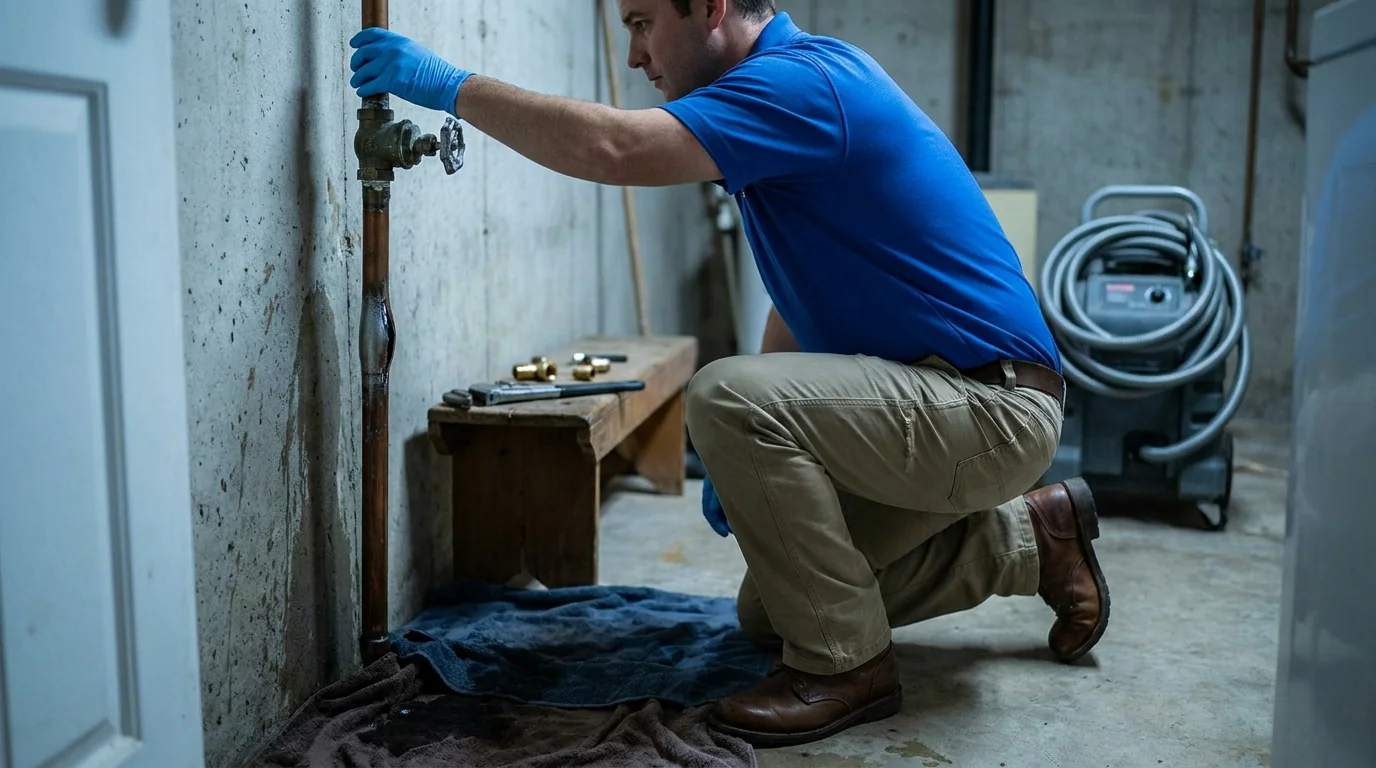
The first priority on any burst pipe call is stopping the water. If the homeowner hasn’t already shut the main, our crew locates and closes it on arrival. From there, the process follows a deliberate sequence calibrated to what Dallas homes actually look like inside.
Source identification and moisture mapping. We use thermal imaging and calibrated moisture meters to trace where water traveled — not just where it’s visible. In a Kessler Park plaster-wall home, water can wick laterally six to eight feet from the break point inside a wall cavity before it ever shows on the surface. We map the full wet boundary before any drying equipment is placed.
Water extraction. Truck-mounted and portable extractors pull standing water from hard floors, carpet, and subfloor assemblies. In slab-on-grade homes common in the 75211 and 75232 ZIP codes, we pay close attention to the gap between the slab and any floating floor system — water pools there and accelerates subfloor delamination if it isn’t extracted promptly.
Structural drying. Desiccant and refrigerant dehumidifiers, along with directed airflow from axial and centrifugal air movers, drive moisture out of framing, sheathing, and wall cavities. Drying logs are recorded daily so there’s a documented record for your insurance adjuster.
Pipe repair and restoration. Once the structure reads dry, we complete the pipe repair — whether that’s a section replacement, a full re-route around a failed galvanized run, or an access opening in a slab for an under-slab break. Affected drywall, insulation, and finish materials are replaced to match existing conditions as closely as possible.
Reaching Dallas from Duncanville
MCC’s base in Duncanville puts the crew close to the southern Dallas neighborhoods that generate the most call volume. The run up US-67 reaches Red Bird and the Kiest Park area quickly; I-35E north covers the Bishop Arts District and Oak Cliff. For properties near Mountain Creek or Dallas Executive Airport, the route along I-20 east keeps travel time short. We don’t publish a minute guarantee — traffic on 67 and 35E varies — but southern Dallas is our primary service corridor and we prioritize it accordingly.
Dallas Insurance Coordination
Most homeowner policies cover sudden and accidental discharge — a burst pipe qualifies; a slow leak that went unaddressed for months typically does not. That distinction matters when the adjuster reviews your claim. We photograph affected materials before any demolition, document moisture readings at each inspection point, and provide a detailed scope of work written in the line-item format most carriers use. That documentation reduces back-and-forth with the adjuster and helps keep the claim on track. We work with most major carriers and can communicate directly with your assigned adjuster throughout the job.
Local Note
Kessler Park and the surrounding streets in the 75208 corridor have a quirk worth knowing: many of the original homes were built with plaster over wood lath rather than drywall, and that assembly behaves differently under a drying protocol. Plaster is dense and releases absorbed moisture slowly — a wall that reads wet on day one may still show elevated readings on day five even with aggressive airflow. Rushing the drying timeline to save a day or two and closing that wall prematurely is one of the more common ways mold gets started behind a “completed” repair in this neighborhood. We extend the drying cycle on plaster assemblies and verify with final moisture readings before any wall closure, which adds a day to the schedule but prevents a much larger problem three weeks later.
If a burst pipe has left standing water, wet walls, or a soaked subfloor anywhere in Dallas — from the Bishop Arts District to Mountain Creek — call MCC Restoration and Contracting Services at (682) 772-9123. The sooner extraction and drying begin, the smaller the repair scope, and the cleaner the insurance claim.
Burst Pipe Cleanup and Repair in Dallas: Service Coverage
Frequently Asked Questions
Are older homes in Kessler Park and Oak Cliff more likely to have a burst pipe than newer construction?
How does Dallas clay soil make burst pipe damage worse compared to other Texas cities?
I'm in the 75232 ZIP code near Red Bird — what's different about burst pipe repair on a slab foundation?
How long does the drying process typically take after a burst pipe in a Dallas home?
Will my homeowner's insurance cover a burst pipe loss in Dallas, and how does MCC help with the claim?
Burst Pipe Cleanup and Repair in Dallas
Our crews are based in Duncanville, TX and take on projects across Dallas. Call for a free estimate.