Burst Pipe Cleanup and Repair in Duncanville
Burst pipe cleanup and repair in Duncanville and surrounding areas. Insurance billing accepted. Call (682) 772-9123.
A pipe doesn’t announce itself before it bursts. One morning you walk into a hallway and the carpet squishes underfoot. Or you come home to a ceiling that’s bowed and dripping, with water already wicking into the drywall behind it. Within the first hour, water from a broken supply line or frozen copper fitting can saturate subfloor, insulation, and wall cavities that look completely dry from the outside — and that hidden moisture is exactly what turns a plumbing emergency into a months-long mold problem if the cleanup isn’t done right.
What burst pipe cleanup and repair actually involves
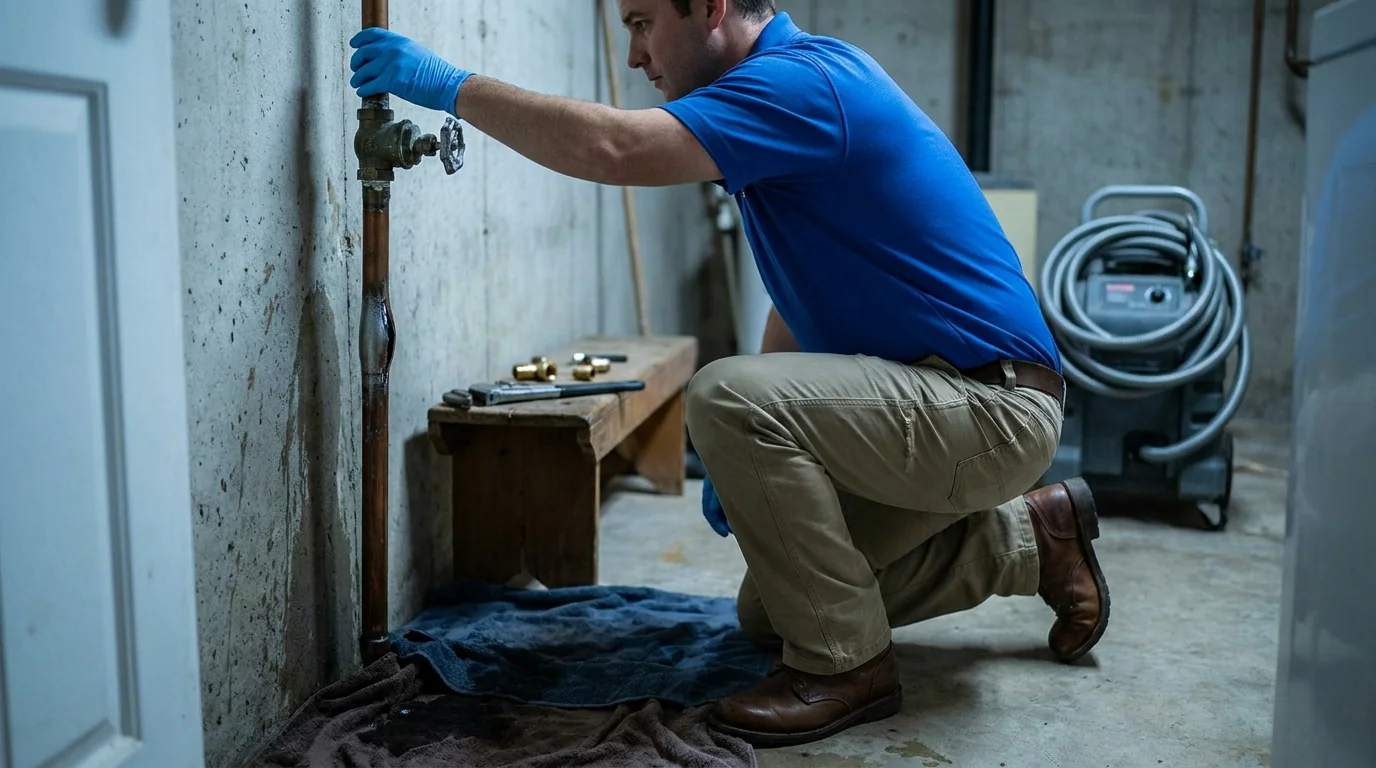
Burst pipe cleanup is not the same as mopping up a spill. When a pressurized line fails — whether it’s a copper supply line, a PEX fitting, or a galvanized drain — water moves fast and follows gravity and capillary action into every available space. It saturates insulation inside walls, travels along joists into adjacent rooms, and pools under flooring where it can sit undetected for days.
The cleanup side of the work involves extracting standing water with truck-mounted or portable extraction units, then setting commercial-grade desiccant or refrigerant dehumidifiers and high-velocity air movers to drive moisture out of structural materials. Depending on how long the water sat and what it contacted, the affected area may require controlled demolition — removing baseboards, cutting drywall flood cuts, or pulling up flooring — to allow air circulation to reach saturated cavities. Moisture readings are taken at multiple depths using both pin-type and non-invasive meters throughout the drying period, typically every 24 hours, until materials reach documented dry standard.
The repair side follows: once materials are dry and documented, damaged drywall, insulation, subfloor, and trim are replaced, and the failed pipe or fitting is repaired or relined. The goal is to hand the space back in pre-loss condition, not just structurally sound but visually finished.
Our process
-
Arrival and source confirmation — Before any cleanup begins, the water source is confirmed stopped. If the homeowner hasn’t already shut off the main, that happens first. We identify whether the break involved a clean supply line (Category 1), a drain or gray-water line (Category 2), or anything involving sewage (Category 3), because that classification drives every decision about PPE, containment, and material salvageability.
-
Moisture mapping — We walk the full affected area with thermal imaging and moisture meters, not just the visibly wet zone. Water from a burst pipe in a second-floor bathroom can travel 15–20 feet along a subfloor before showing up as a stain on the ceiling below. Every affected material and reading is logged and photographed for the insurance file.
-
Extraction and controlled demolition — Standing water comes out first with extraction equipment. Then, where moisture readings show saturation inside wall cavities or under flooring, we perform targeted flood cuts or material removal — the minimum necessary to allow drying, not a gut-and-rebuild by default. Salvageable materials stay; materials that can’t reach dry standard or that show existing mold growth are removed and documented.
-
Structural drying — Dehumidifiers and air movers are positioned based on the moisture map, not just placed in the center of the room. We monitor and adjust equipment placement daily, logging psychrometric data (temperature, relative humidity, GPP) until affected assemblies reach the dry standard for that material type.
-
Pipe repair and reconstruction — Once the structure is dry and documented, the failed pipe or fitting is repaired. Reconstruction follows the same scope used for the insurance estimate: drywall, insulation, flooring, paint, and trim returned to match pre-loss conditions.
What separates a good burst pipe response from a bad one
The most common failure in burst pipe cleanup is stopping at what’s visible. A crew that extracts standing water, runs fans for two days, and calls it dry has almost certainly left moisture in wall cavities, under flooring, or in subfloor sheathing — exactly the conditions where mold colonization begins within 24–72 hours. Insurance adjusters reviewing a subsequent mold claim will look for moisture logs, daily psychrometric readings, and documentation that dry standard was actually reached before equipment was pulled.
A second common problem is misclassifying the water source. A burst washing machine supply line is Category 1 (clean water). A backed-up drain line that failed at the trap is Category 2 or 3. The cleanup protocols, required PPE, and material salvageability decisions are different — and a crew that treats a gray-water loss as a clean-water loss creates a liability and a health risk.
Good operators also document the pipe failure itself — photos of the break, the pipe material, and any visible corrosion or freeze damage — because that documentation supports the insurance claim and helps identify whether adjacent pipes are at similar risk.
Seasonal and regional considerations
North Texas doesn’t get the prolonged freezes that states further north do, but Duncanville and the surrounding DFW area have seen back-to-back hard freezes in recent winters that caught a lot of homes off guard. Older homes in southern Dallas County — many built in the 1960s and 70s with copper supply lines in exterior walls or uninsulated attic runs — are especially vulnerable when temperatures drop into the teens for more than 24 hours. When a freeze event hits the region, burst pipe calls spike within 12–36 hours of the thaw, as ice that was holding pressure in place melts and the break becomes apparent. If your home is older and you’re seeing low water pressure after a cold snap, that’s worth investigating before the ceiling tells you about it.
Service area
MCC Restoration and Contracting Services is based in Duncanville and handles burst pipe cleanup and repair throughout the southern DFW metro, including Cedar Hill, DeSoto, Lancaster, Midlothian, Mansfield, Grand Prairie, and surrounding communities in Dallas and Tarrant counties.
If you’re standing in a wet room right now, call (682) 772-9123 to schedule your moisture assessment and get a documented scope of the damage before more of the structure is affected.
Frequently Asked Questions
How do I know if water from a burst pipe reached inside my walls, even if the floor looks dry?
What is a 'flood cut' and when is one actually necessary after a pipe break?
Does the water source category affect what gets repaired versus replaced?
How long does structural drying typically take after a burst pipe?
What documentation should I keep for my insurance claim after a burst pipe?
Looking for the best burst pipe cleanup and repair company in Duncanville?
MCC Restoration and Contracting Services provides burst pipe cleanup and repair in Duncanville, TX and the surrounding area. Call (682) 772-9123 for a free estimate.
Need Burst Pipe Cleanup and Repair now?
We respond fast across Duncanville and surrounding TX cities.